
News
Energy Efficiency Grants 2025 in the Valencian Community: A Key Opportunity for Large Companies
- 20/10/2025
- Energy Efficiency Grants
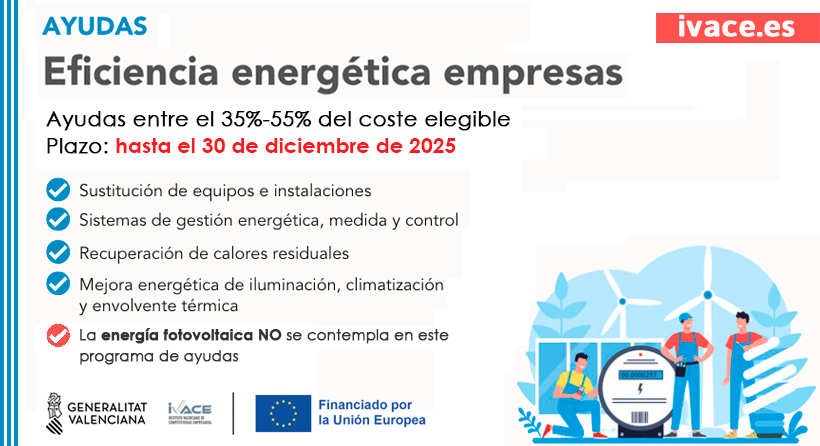
In today’s corporate environment, energy efficiency is no longer optional — it has become an essential strategy for companies to remain competitive, scale their operations and adapt to a more sustainable future. If you manage large industrial, agro-food, commercial or service-sector facilities, this grant opportunity is designed for you. The Instituto Valenciano de Competitividad Empresarial (IVACE) has launched its 2025 Energy Efficiency Grants programme, open to companies with headquarters or production centres in the Comunitat Valenciana that wish to reduce energy consumption, modernise their installations and improve their competitiveness through sustainable investments.
At AGB Ingeniers, we specialise in the comprehensive management of energy-efficiency grants, underpinned by a proven track record and 100 % success rate in grant processing and award. Our technical team supports each company throughout the entire process — from the initial audit to the final certification — ensuring that every project meets the technical and administrative requirements set by IVACE.
We take care of everything so that your organisation can focus on its core business while maximising the return on your investment:
-
Audit and calculation of energy savings: we analyse the current state of your facilities and quantify the potential savings that the improvement will deliver. This phase is critical to demonstrate the real impact of the project and to ensure its eligibility.
-
Preparation of the technical report and IVACE documentation: we produce all the required documentation with technical precision and regulatory rigour to guarantee that the application meets the evaluation criteria in full.
-
Online submission and administrative follow-up: we manage the complete process before the administration, tracking deadlines, handling any requests for clarification or correction, and following up until final resolution — relieving your team of bureaucratic burden.
-
Coordination of suppliers and certifications: we oversee the execution of the project and the final certification, verifying that the installed improvements comply with the committed energy-efficiency standards.
Thanks to our experience and methodology, AGB Ingeniers has become a reference in the management of public grants in the Valencian Community, assisting small, medium and large companies to obtain non-repayable funding for their modernisation and sustainability investments.
Why is this type of grant so important?
Energy efficiency is more than a technical matter — it is a strategic business decision that redefines how companies produce, consume and compete. Committing to energy-saving projects means investing directly in competitiveness, sustainability and profitability. Below, we explain the main benefits a company obtains by opting for the IVACE energy-efficiency grants and the programmes managed by AGB Ingeniers.
Reduction in energy costs
Large companies often have high electrical and thermal consumption due to the scale of their facilities and production processes. Investing in energy efficiency allows you to significantly reduce those consumptions, optimise resource use and reduce your energy bill on a monthly basis. With better-controlled consumption, operating margins improve and the company can redirect those savings to innovation, development or expansion. Moreover, the technological upgrades applied — such as high‐efficiency equipment, heat recovery systems or energy-monitoring systems — reduce energy dependency and contribute to greater financial stability.
Improvement of industrial competitiveness
By modernising installations, automating processes and optimising control systems, you don’t just reduce energy expenditure — you also increase productivity, quality and the reliability of the entire production chain. Companies that invest in energy efficiency enhance their overall performance and achieve more stable, safer and profitable operations. In sectors such as agro‐food, industry or logistics, this modernisation is key to maintaining competitiveness in an increasingly demanding market. Energy efficiency thus becomes a lever of innovation and guarantees long-term operational continuity.
Regulatory compliance and sustainability
In a transition towards low-carbon economies, companies are increasingly required to meet regulations related to energy savings and emission reduction. Implementing efficiency improvements not only ensures regulatory compliance, but also strengthens corporate reputation and ESG (Environmental, Social & Governance) commitments. Companies that act proactively anticipate future regulations, meet investor and customer expectations, and reinforce their market position as sustainable and environmentally responsible organisations.
Access to non-repayable funding
One of the greatest attractions of these initiatives is the access to grants that do not have to be repaid. The IVACE energy-efficiency subsidies finance between 35 % and 55 % of the investment, depending on company size. This financial support turns projects that might take years to amortise into highly viable opportunities. Thanks to this direct funding, companies can undertake machinery replacement, process optimisation or improvements in lighting and HVAC without compromising their liquidity. In short, it’s an opportunity to accelerate technological modernisation with a guaranteed return in the short term.
Brand enhancement and internal commitment
Beyond economic savings, energy-efficiency actions generate a positive impact on brand image and internal engagement. Organisations that demonstrate a real commitment to sustainability project themselves as modern, responsible and innovative to their clients, suppliers and institutions. Furthermore, these projects engage internal teams, who recognise improved working conditions and the company’s effort to adopt more responsible and sustainable management. Energy efficiency becomes a symbol of advanced corporate culture, able to attract talent, retain customers and strengthen corporate reputation.
Details of the 2025 Grant Call
Call open – Valencian Community
The IVACE has launched its 2025 Energy Efficiency Grants programme, aimed at companies in the Valencian Community that wish to reduce consumption, modernise their installations and enhance competitiveness through sustainable investments.
Eligible beneficiaries
-
Small, medium and large companies of any sector, with headquarters or production centre in the Valencian Community.
-
Eligible installations include industrial, agro-food, commercial or service-sector facilities.
Eligible actions
-
Replacement of machinery or equipment with more efficient units.
-
Improvement of thermal insulation, lighting, HVAC and electrical systems.
-
Incorporation of control systems, automation and energy-monitoring systems.
-
Heat-recovery and optimisation of production processes.
(Note: maintenance or renewal without demonstrable efficiency improvement is not eligible.)
Aid intensity
| Company size | % Subsidy on eligible investment |
|---|---|
| Small enterprise | Up to 55 % |
| Medium enterprise | Up to 45 % |
| Large enterprise | Up to 35 % |
Direct funding, non-repayable, on investment costs.
Application period
Open until 30 December 2025 (subject to available budget — the earlier you submit, the higher the probability of approval).
Basic requirements
-
Project with quantifiable energy savings and technical audit.
-
Investments must not be initiated before submission.
-
Improvement must be maintained for at least 5 years.
-
Company must be up to date with the tax agency (AEAT), Social Security and regional government.
Objective
To reduce energy consumption and emissions, promoting technological modernisation and the transition towards a more sustainable economy.
Key tips for companies to maximise the call
-
Act promptly
As the deadline is 30 December 2025 and the call is subject to budget availability, speed is vital. The sooner your project is submitted with correct documentation, the greater the chances of approval. -
Define a project with quantifiable energy savings
The technical audit must prove, with data, that your investment will deliver measurable savings. This involves analysing current consumption, establishing a baseline and projecting the post-intervention scenario. Large companies have greater potential to achieve significant savings — which can strengthen the case. -
Select actions with focus
While the call allows multiple interventions, not all actions yield the same impact or feasibility for large companies. Prioritise:-
Replacement of outdated or low-efficiency machinery with state-of-the-art equipment.
-
Control systems, automation and energy-monitoring: crucial when your facility is large and you seek optimisation.
-
Heat recovery or process improvement: where large companies can leverage scale to greatest effect.
-
Improvements to lighting, insulation or HVAC: though these may have smaller immediate impact, they contribute to a comprehensive efficiency plan.
-
-
Plan the investment and savings maintenance
It is essential that investments have not been started before submission and that the improvement is sustained for at least five years. This means the enterprise must commit to preserve the equipment or installation, monitor performance and track savings over that period. -
Leverage specialist advice
For large companies, the bureaucracy and technical requirements can require significant effort. A partner such as AGB Ingeniers enables:-
Minimising risk of errors in documentation or deadline management.
-
Ensuring the technical audit and report comply with the call’s criteria.
-
Overseeing execution, coordinating suppliers and certifying that installed equipment meets the required efficiency improvement.
-
Managing the administrative follow-up and investment/tracking justification.
-
-
Communicate to internal and external stakeholders
When a large enterprise secures an energy-efficiency grant, it not only reduces costs but also enhances its sustainability credentials. Communicate:-
To clients and suppliers: your company is adopting an energy-efficiency strategy.
-
To internal teams: modernisation improves working conditions, safety, automation and productivity.
-
To financiers or investors: a company committed to energy efficiency has lower regulatory risk and greater appeal.
-
Why large enterprises have more to gain
-
Scale of savings: With high consumption, small percentage improvements translate into major absolute savings. For instance, a 10 % reduction in consumption in a multi-megawatt plant can represent a significant financial benefit.
-
Investment capacity: Large enterprises often have the capacity to undertake robust investments in machinery, automation, heat recovery or process optimisation.
-
Return on investment: Although the subsidy covers up to 35 % for large companies, this is still significant. Moreover, the remainder of the investment amortises through operating-cost savings and other collateral benefits (such as reduced maintenance, higher reliability, less obsolescence).
-
Reputation and ESG strategy: For large companies with sustainability, corporate social responsibility (CSR) or ESG commitments, such grants help fulfil the strategy and generate concrete reports of energy improvement.
-
Competitive advantage: Modernising ahead of competitors can deliver a meaningful edge in costs, technical capability, brand image and preparation for future regulation.
Integrating the subsidy into your corporate strategy
To leverage this call effectively, view it not as a one-off exercise but as part of your company’s global energy strategy. Here are key recommendations:
-
Conduct a comprehensive energy diagnosis: analyse consumption patterns, peaks, inefficient systems, loss-making processes, idle loads and potential for heat/energy recovery.
-
Define a multi-year action plan: although the grant is for 2025, you can structure improvements in phases (machinery, control, automation, building envelope etc.). The grant helps launch the first phase.
-
Establish monitoring metrics and indicators: energy performance, consumption per production unit, demand variation etc. This helps justify the subsidy and demonstrate results.
-
Choose suppliers and equipment based on efficiency criteria, certifications and appropriate lifespan.
-
Consider internal or complementary financing: the grant covers some investment; the remainder can be financed via leasing, green finance or through energy-services contracts (ESCOs).
-
Communicate both internally and externally: engage teams (maintenance, production, engineering) so the initiative succeeds and endures. Also highlight the initiative in corporate communications (website, sustainability report, customers).
-
Prepare for post-investment justification and maintenance: save invoices, technical documentation, carry out periodic measurements and document that the improvement has been maintained for at least five years — as required by the call.
Risks and aspects to keep in mind
While IVACE’s energy-efficiency grants represent an exceptional opportunity to cut costs and modernise your installations, it is vital to be aware of certain technical and administrative aspects that may affect approval. At AGB Ingeniers we have extensive experience in grant management and know that a well-planned start can avoid mistakes that might invalidate the subsidy or reduce its value. The main risks and requirements every company should know before submitting are:
-
Starting investments before submitting the application: This may invalidate the grant. The requirement is that investments must not have begun prior to submission.
-
Under-estimating actual savings: If the audit fails to justify sufficient savings or no measurable efficiency improvement is shown, the justification may be compromised.
-
Lack of follow-up on installed equipment: If after the investment you don’t monitor performance, you lose the guarantee that the savings will persist.
-
Rapid technology changes: Large enterprises must select technologies that won’t become obsolete quickly; a strategic approach is essential.
-
Submission deadline and budget exhaustion: Although the deadline is 30 December 2025, since the call is subject to budget availability, applications submitted later may have a lower probability of approval.
-
Five-year maintenance commitment: It is important to ensure that the company can maintain the improvement throughout that period — in operational terms, cleaning, maintenance, monitoring and continuous improvement.
Knowing these details can make the difference between a granted subsidy and a missed opportunity. At AGB Ingeniers we support you at every step, ensuring that your application meets all requirements and is executed successfully, thus securing the maximum funding possible and the genuine sustainability of your investment.
For large companies established in the Valencian Community operating in industrial, agro-food, commercial or service sectors, this 2025 IVACE energy-efficiency grant call represents a strategic opportunity. Not only because of the non-repayable financial support, but also because of the technological transformation it entails: more efficient machinery, advanced control systems, optimised processes, lower costs and greater sustainability.
Energy efficiency is no longer just a cost-saving measure: it becomes a vector of competitiveness, responsibility and the future of business. If you are considering reducing consumption, modernising your installation, optimising production and reaching higher standards of sustainability — now is the time.
At AGB Ingeniers we are ready to assist you in every phase: audit, document preparation, submission, coordination and follow-up. Do not let the 30 December 2025 deadline pass — contact us and take the step towards a more efficient, sustainable and competitive company today!