
News
Industrial Climate Control: a Strategic Factor for Productivity, Energy Efficiency, and Workplace Well-Being
- 08/12/2025
- Energy Efficiency Grants
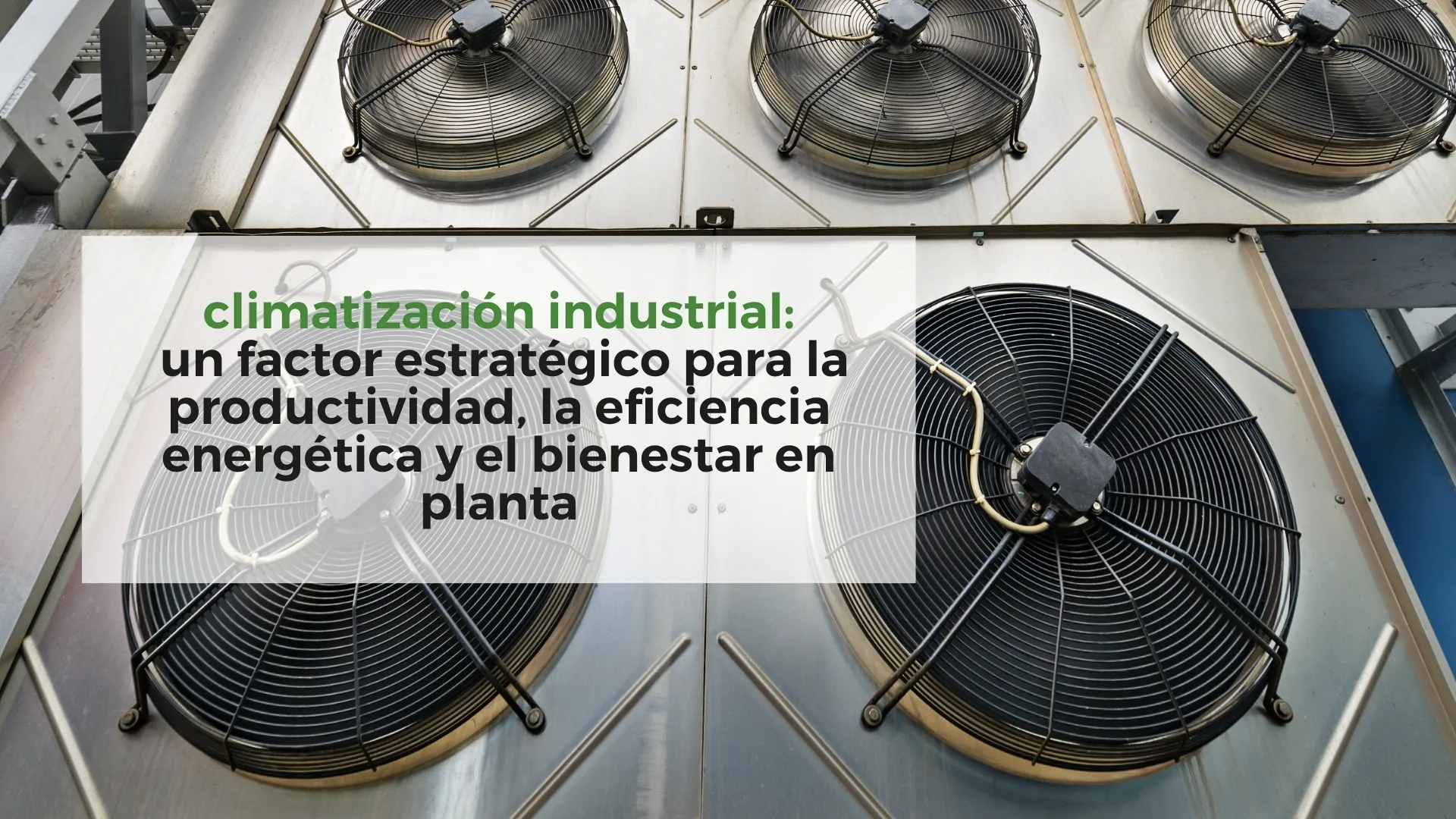
Industrial climate control is a key factor for improving energy efficiency, productivity, and well-being in any industrial plant in the Valencian Community. Having well-designed climate control systems allows temperature regulation, consumption reduction, and optimization of production processes. At AGB Ingeniers, we analyze each installation to offer efficient climate control solutions tailored to each industry and aligned with current sustainability and competitiveness requirements.
By Ana González, CEO and Agronomist Engineer – Industrial consultant in energy efficiency and grants management at AGB Ingeniers
For years, I have visited production plants across the Valencian Community: from food industries and wineries to packaging factories, metal workshops, logistics centers, fruit and vegetable warehouses, and technology companies. In all of them, regardless of size or sector, there is a common element that conditions daily operations, product quality, and employee well-being: industrial climate control.
Unlike domestic or commercial air conditioning, climate control for industry does not seek thermal comfort alone; it seeks stability, control, and efficiency. It directly affects machinery performance, the preservation of raw materials and finished products, occupational safety, and of course, the company’s energy costs. However, many industries continue to treat it as a secondary aspect when, in reality, it is a strategic pillar to ensure production continuity, regulatory compliance, and improved competitiveness.
At AGB Ingeniers, we see every day how an adequate climate control installation can transform an entire plant. A warehouse that once experienced overheating in summer now maintains stable processes; a chamber or handling room that once suffered product losses due to poor thermal control now works with millimetric precision; electronic equipment that previously failed due to high temperatures stops being a risk. All this translates into energy efficiency, cost reduction, and a safer, healthier working environment.
The real need for industrial climate control
I often meet business owners who question whether they really need an industrial climate control system. In most cases, the answer is yes. Even in sectors where it was not traditionally considered a priority, current requirements for quality, safety, and productivity have completely changed the landscape.
Temperature, humidity, and air quality influence essential factors such as product shelf life and process speed. For example, in the food industry, unstable temperatures can compromise product safety or generate condensation that affects handling. In logistics companies, maintaining a controlled environment prevents damage to sensitive materials and improves staff performance. In metal industries or workshops, excessive heat reduces precision and comfort, affects material behavior, and shortens machinery lifespan.
Furthermore, industrial climate control is no longer merely operational: it is also an issue of occupational safety. Thermal stress is a recognized risk. A facility with high summer temperatures endangers workers’ health and significantly reduces their performance. Inspections and audits increasingly require corrective measures to ensure thermal well-being.
For all these reasons, industrial climate control is not a luxury or an accessory: it is a requirement to work well, produce better, and comply with regulations.
Different climate control systems depending on the type of industry
One of the most complex aspects for any company is understanding which climate control system it needs. There is no universal solution. Each plant requires a tailored design depending on its activity, dimensions, thermal loads, personnel, machinery, and products.
Below, I describe some of the most relevant systems and the cases in which they are most suitable, although a detailed technical study must always be carried out before making decisions.
Industrial evaporative cooling
This is common in large industrial buildings where the goal is to reduce temperature with an economical, low-consumption system. It works very well in dry or semi-dry areas, and in processes not sensitive to humidity. Its ability to continuously renew the air improves environmental quality and reduces pollutant concentration.
Direct expansion systems
These are more controlled and precise systems using cooling units with Inverter technology. They are used in handling rooms, offices inside the plant, laboratories, or areas where temperature requires strict control.
VRV/VRF climate control
These systems allow modulation of climate control across different spaces within the same industry with high energy efficiency. They are especially useful when there are multiple zones with different thermal requirements: offices, technical rooms, production areas, and warehouses.
Industrial ducted climate control
This involves air distribution through ducts, allowing large spaces to be climatized uniformly. It is very useful for industries with processes sensitive to ventilation or where thermal stratification must be avoided.
Climate control systems for technical rooms
In industries with servers, advanced electronics, robotics, and control equipment, climate control is essential. In these cases, precision systems (such as CRAH/CRAC units) are used, allowing continuous control of temperature and humidity.
Industrial aerothermal systems
More and more companies consider this a real option due to its high energy performance. It harnesses energy from the air to generate cooling or heating with significantly lower consumption. Combined with intelligent control systems, it becomes one of the most efficient solutions on the market.
Hybrid and mixed systems
Often, the best option is not a single system, but a combination adapted to production, thermal loads, and working schedules. The key is to design a solution that provides performance, stability, and savings.
At AGB Ingeniers, we analyze each case individually, studying plans, workflows, thermal loads, stored materials, and process requirements to propose the most suitable and efficient solution.
The role of engineering in industrial climate control
Installing a climate control system is not simply choosing equipment and placing it. Engineering plays a fundamental role in ensuring the system works as it should, consuming only what is necessary and maintaining optimal conditions without fluctuations.
A good industrial climate control project begins with a rigorous analysis of thermal loads, orientation, internal processes, heat emissions from machinery, outdoor air intake, useful volume, humidity, and environmental factors specific to each sector. This is where the difference lies between an installation that “works” and one that truly transforms the plant.
When we design a solution for a client, we aim for climate control to not only solve a specific problem but also improve energy efficiency, process stability, and indoor environmental quality. To paraphrase replicant Roy Batty in Blade Runner, I have seen companies increase productivity simply because their workers were no longer operating in extreme thermal environments. I have seen cold rooms stabilize their consumption after proper climate control engineering. I have seen technical rooms double their lifespan thanks to adequate thermal control. And these results translate into real energy savings.
This is because one aspect often goes unnoticed: efficient climate control reduces the plant’s total electrical consumption. When the working environment is balanced, machines operate with less effort, motors dissipate less heat, electronic equipment functions more stably, and processes require fewer cycles.
Efficient climate control and the energy transition in industry
Industrial climate control is now a key measure for advancing toward more sustainable energy models. It is not just about improving comfort or operations: it is about reducing energy consumption and progressing toward the efficiency objectives promoted by Europe and the Valencian Community.
Current systems allow heat recovery, consumption modulation, renewable energy integration, and real-time performance monitoring. Aerothermal technology, VRF/VRV systems, and hybrid solutions significantly reduce energy demand—something unthinkable in large-scale industrial environments only a few years ago.
All this technological progress has a direct impact on profitability. Modern industrial climate control offers fast returns thanks to consumption reduction, improved machinery performance, and fewer stoppages or product losses.
A key moment: IVACE energy efficiency grants
I would also like to highlight a strategic aspect: many industrial climate control actions are eligible for IVACE energy efficiency grants. These grants are specifically designed to support the Valencian industrial sector in modernizing its installations, and climate control plays a fundamental role.
The grants are structured into four major action groups:
-
Replacement of existing equipment and installations, including more efficient climate control solutions that replace old or high-energy-consumption systems.
-
Improvement of the energy performance of industrial processes, where climate control is used to stabilize conditions and reduce electrical consumption.
-
Incorporation of high-efficiency technologies, such as aerothermal systems, VRV/VRF, or intelligent monitoring systems.
-
New investments that reduce overall energy consumption, allowing complete reform or redesign of a plant’s climate control system to convert it into a more efficient model.
At AGB Ingeniers, we support our clients throughout the entire process: from the initial technical analysis to grant processing and final justification. We know these investments not only improve industrial environmental quality