
News
REA in the Valencian Community: What Exactly Must Be Declared and Why It Matters in the Food Industry
- 19/01/2026
- RI REA
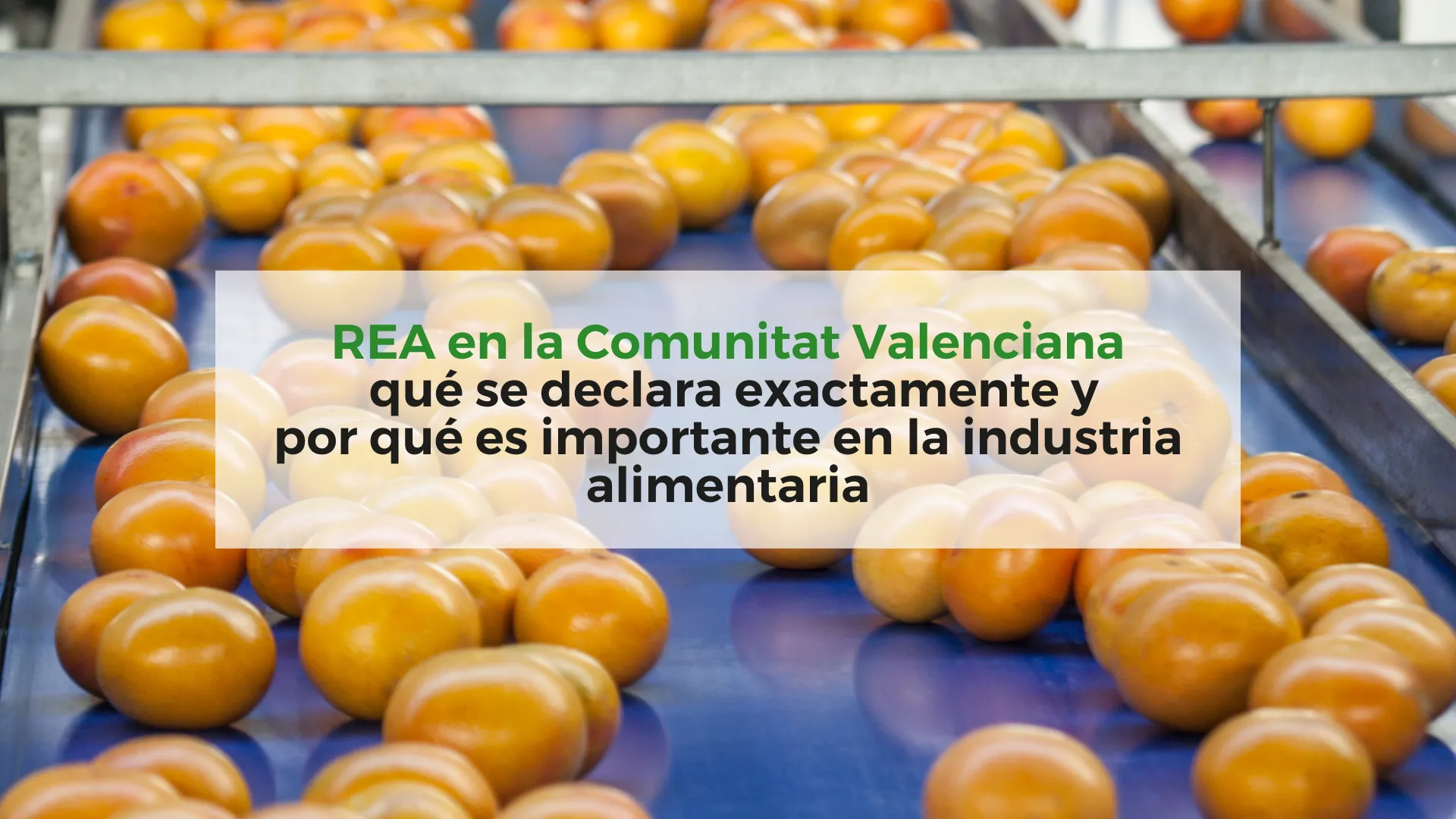
In the agri-food industry in the Valencian Community, the REA (Agri-Food Industry Register) is not a simple formality: it is a living document that accurately reflects your process, capacities and machinery. Keeping it up to date provides security during inspections and audits, and becomes especially decisive when the time comes to apply for grants and subsidies, justify investments or demonstrate technical consistency to the administration.
By Ana González, CEO and Agricultural Engineer – Industrial consultant in energy efficiency and grant management at AGB Ingeniers
In the food industry, some decisions are easy to make because they are visible: a new production line, an investment in machinery, a capacity expansion or an upgrade to a cold storage room. However, there are other aspects that, although less tangible, largely determine a company’s safety and stability when the time comes to grow, undergo an audit, apply for grants or face an inspection. One of these is the REA, the Agri-Food Industry Register, which is especially relevant for companies with production activity in the Valencian Community.
Often, when a company hears the word “register”, it automatically associates it with a formality. But the REA is not just any formality. In practice, it is a kind of official snapshot of the business. A living document that describes, with a higher level of detail than usual, what is produced, how it is produced and with which technical means it is produced. That is why understanding what must be declared in the REA —and doing it properly— makes an enormous difference between an industry that moves forward with peace of mind and one that ends up dealing with administrative urgencies at the worst possible time.
From my experience at AGB Ingeniers, supporting food industries in the Valencian Community, I have seen that the main problem is not the complexity of the register, but the lack of awareness of its scope. Many companies believe it is enough to “be registered”, without checking whether what appears in the REA truly represents the plant, the process and the current machinery. That is where inconsistencies usually begin to appear.
The REA as a “scanner” of the production process
The REA does not simply state that “there is a food industry at this location”. It goes much further. What the administration seeks is an organised and verifiable view of industrialised agri-food activity. This requires describing the nature of the activity, the establishment and the production process with industrial logic.
In practical terms, the REA includes information related to the identification of the production site and, above all, the activity carried out: which products are manufactured or handled, which types of processes are applied (processing, packaging, preservation, preparation, etc.) and what the real scope of that production is. In the Valencian Community this is especially important because the agri-food fabric is broad and diverse: fruit and vegetables, citrus, preserves, nuts, industrial bakery, fresh-cut (IV range) and ready-to-eat (V range), beverages, oils, etc. Each sub-sector has its own particularities, and the register must reflect them accurately.
But what truly differentiates the REA is not only the declared activity. It is the level of detail it reaches when describing the production process and the technical means involved.
Machinery: the heart of the REA
If I had to summarise in one sentence why the REA is different, I would say this: in the REA, machinery matters. And it does not matter as a generic list, but as part of the coherence of the process.
In a food industry, the production process is defined by the machines involved at each stage. That is why the REA pays attention to the equipment and lines that make industrialised production possible. Depending on the activity, we are talking about washers, graders, peelers, cutters, mixers, pasteurisers, ovens, filling lines, labellers, cooling tunnels, cold rooms, compressors, water treatment systems, inerting equipment, and much more.
The logic of the register is simple: if an industry declares a type of production, it must be possible to demonstrate that the existing machinery is consistent with that production and with its real capacity. When this is not the case, problems begin: for example, a plant that expands a line, installs additional machinery or increases capacity, but keeps an REA that describes a previous reality. At that point, the register stops being a faithful snapshot and becomes a source of inconsistencies.
Capacities, flows and industrial coherence
In addition to machinery, the REA includes another critical element: capacity. Not only what is produced, but how much can be produced and under what conditions. This connects with the idea that the register is a complete “scanner”: it describes the process, the stages, the installed capacity and industrial operation, with special attention to food safety, sanitary control and traceability.
In practice, this requires companies to approach the register with an industrial mindset: process lines, areas, production sequence, inputs and outputs. It is not about filling in fields, but about telling a technical truth: how that industry works today.
And this is where many companies in the food industry in the Valencian Community fail without realising it: they change the process over time, adapt flows, improve installations, introduce automation, but the REA remains like a snapshot from the past. That disconnect may go unnoticed for years… until the moment arrives to certify, justify or demonstrate coherence to a third party.
Why does doing it well matter so much?
Because the REA is not an isolated document. In the real life of a food industry, the REA appears indirectly at key moments: inspections, audits, expansions, changes of ownership, investment projects, certifications or grant applications. The administration or project-evaluating bodies do not always ask for “the REA” explicitly, but they often verify the company’s documentary consistency.
When the REA is well prepared, the company gains peace of mind and agility. When it is not, the company is exposed to requests, delays and corrections that usually arrive when time is tight. At AGB Ingeniers we see it often: industries that need to execute an investment, process an energy improvement or justify a project, and discover that the first step is “bringing the REA up to date”.
In addition, the REA is a key piece in supporting a serious industrial strategy. Having it well built forces the company to organise its process, identify critical machinery, define capacities and properly document its productive reality. In a way, it is a structuring exercise that strengthens the company, even when there is no inspection on the horizon.
The AGB Ingeniers approach
At AGB Ingeniers we work on the REA from a technical and strategic perspective. It is not about “processing a register”, but about building a coherent, verifiable document aligned with the real plant. And in the food industry, that coherence is achieved through site visits, process analysis, machinery identification, capacity review and technically sound drafting.
My recommendation, if you are an agri-food industry in the Valencian Community, is clear: do not wait until the REA is demanded at the worst possible time. Review it, update it and turn it into a stability tool. Because growing is much easier when the administrative foundation accurately reflects what the industry is, what it produces and how it produces it.