News
INPYME 2026 Grants Now Published: A Real Opportunity to Modernize the Plastics Industry in the Valencian Community
- 16/02/2026
- Aids
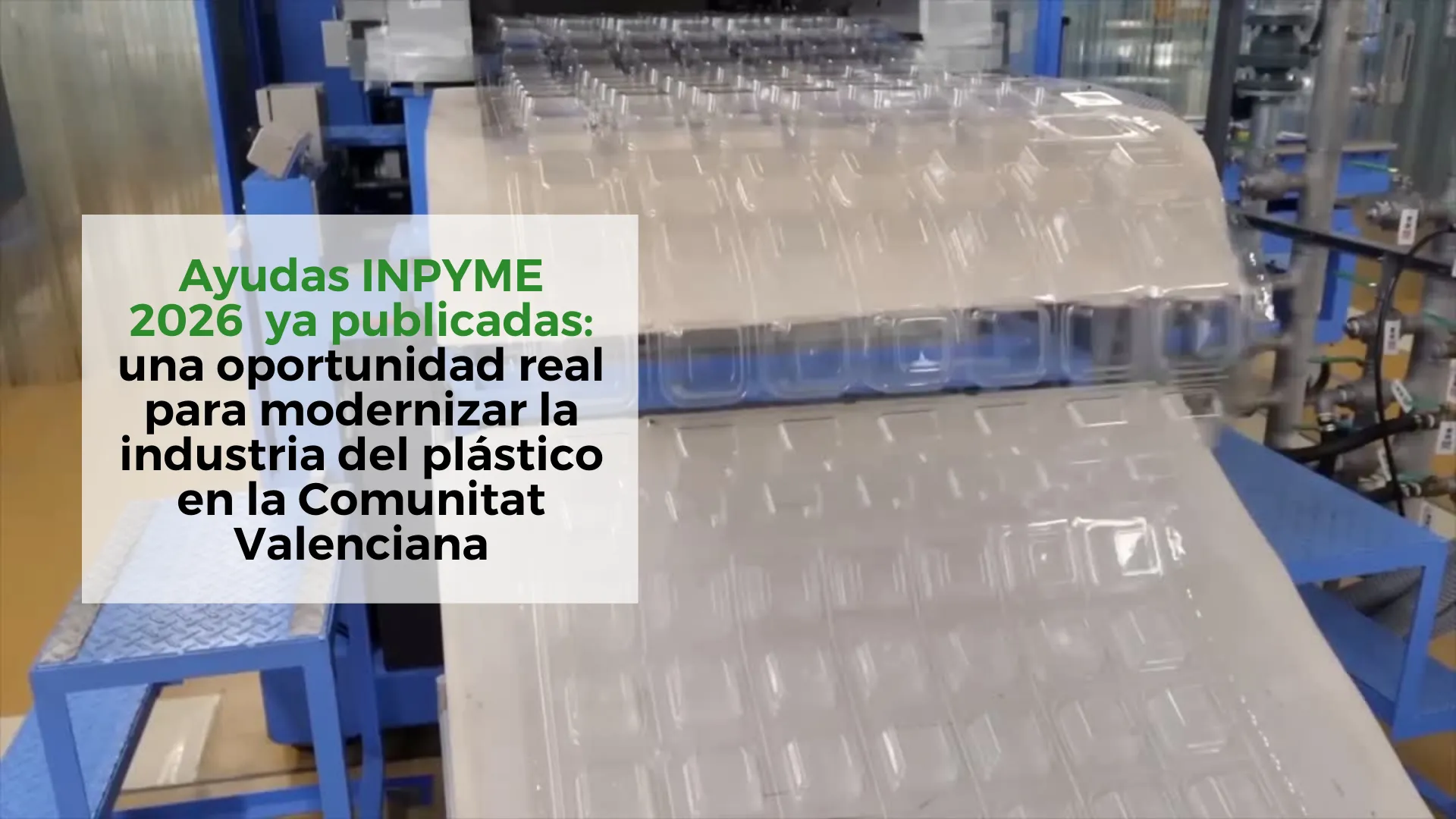
The INPYME 2026 Grants have already been published and open a short window for industrial SMEs in the Valencian Community to drive investments in modernization, automation, and digitalization with a real impact on competitiveness. The application period runs from 16/02/2026 to 10/03/2026 and the process is based on competitive selection, so it’s not enough just to apply: you have to do it well. In the plastics industry, where efficiency, quality, and traceability define margins, being prepared is the difference between securing the grant… or missing out.
By Ana González, CEO and Agricultural Engineer – Industrial Consultant in energy efficiency and grant management at AGB Ingeniers
They’re here. The INPYME 2026 Grants have been published and open a short, but very valuable, window for industrial SMEs in the Valencian Community to promote investments with an industrial mindset: modernization, automation, digitalization, and improved competitiveness. The application period starts on 16/02/2026 and ends on 10/03/2026, and the call is processed under competitive selection. In other words: it’s not enough just to “make it”; you must submit a solid project.
At AGB Ingeniers we’ve been supporting industrial companies through these processes for years, and if there’s one thing I’ve learned from day-to-day work with clients, it’s that making the most of a grant is not about “asking for money”. It’s about turning a necessary investment into a defensible project, with technical coherence, documentary traceability, and measurable objectives.
What INPYME 2026 is and why it matters (for real)
INPYME 2026 is a call from the Generalitat Valenciana aimed at boosting industrial investments. The published budget is significant (€49.3M), and the approach matches what many factories need to stay competitive: renewing equipment, improving processes, digitizing control, and reducing inefficiencies that, in a demanding market, are costly.
In addition, the grant falls under the de minimis regime (Regulation (EU) 2023/2831). This has practical implications: it’s advisable to review the history of aid received in recent years so as not to compromise eligibility or the level of support for the application.
And one key nuance: the application is submitted online through the Generalitat’s e-government portal. The form matters, but what usually decides is the substance: the quality of the application dossier.
The INPYME 2026 opportunity seen from the plastics industry
If we talk about the plastics industry in the Valencian Community, we’re talking about a sector that constantly balances productivity, energy costs, quality, customer requirements, and regulatory pressure. Processing, injection molding, extrusion, blow molding, thermoforming, compounding, recycling, and valorization… each activity has its own challenges, but almost all of them share four realities:
-
Margins are won through efficiency, not intuition.
-
Process variability (raw material, temperature, humidity, cycles) affects scrap and reprocessing.
-
Competitiveness is no longer just price: it’s traceability, consistency, lead times, certifications, and compliance.
-
The technological leap doesn’t happen “in bits”: you plan it, or it becomes a source of downtime.
In this context, INPYME 2026 can be the push to execute investments that many companies have been postponing: machinery replacement, automation of critical points, sensors, industrial software, ERP/MES integration, in-line quality improvement, reduction of auxiliary consumption, and workflow reorganization.
Key points of the call you need to have clear
If you’re considering INPYME 2026, the first step is to clearly understand the call’s “map” — without noise and with an industrial mindset. This is a grant aimed at SMEs — and also self-employed individuals with economic activity — provided the project is carried out in the Valencian Community. It’s not an open-ended call: the deadline is short and very specific, from 16/02/2026 to 10/03/2026, and that completely changes the approach. Here, the winner isn’t the one who rushes on the last day; it’s the one who arrives with a well-structured project.
Also, this is not a “first come, first served” grant. The procedure is competitive selection, meaning your application competes with other projects in the same industrial ecosystem. So it’s not enough to comply: you must justify coherently, document well, and present an investment that can be understood, sustained, and defended. All of this is framed within the regulatory bases set out in Order 1/2024, under the Valencian Community’s reindustrialization strategy, and it is applied under the de minimis regime of Regulation (EU) 2023/2831, which is important to keep in mind to avoid hitting limits due to accumulated aid.
Processing is also 100% online, through the e-government portal, which requires documentary order from the start: forms, annexes, technical report, quotes, accreditations… everything must match on the first attempt, because with such a tight deadline, mistakes are costly.
And from here, the key point is not “Does it interest me?”. In plastics, it almost always does. The real question — the one that makes the difference — is: How do I prepare a project with real chances of being awarded?
The investment that truly changes a plastics factory
In the plastics industry, investments that generate real impact usually fall into one of these families:
Machinery modernization (and not just “changing for the sake of changing”).
A new injection molding machine is not just a machine: it’s cycle stability, repeatability, energy efficiency, less scrap, and less dependence on “artisan” adjustments. In extrusion, an improvement in thermal control, screw, or die can translate into tighter tolerances, fewer rejects, and better sustained productivity. In blow molding or thermoforming, the difference between “producing” and “producing well” shows up in consumption, scrap, thickness control, and stability across shifts.
Automation at critical points.
Extraction robotics, stacking, packaging, machine vision for quality control, feeding and dosing systems, internal handling… In plastics, automation is not a whim: it reduces variability, stabilizes quality, reduces dependence on labor for repetitive tasks, and improves safety.
Industrial digitalization: data that helps you produce, not decorate dashboards.
Sensors, parameter capture, alarms, useful dashboards, ERP/MES integration, batch traceability, consumption control by machine or by reference… When a plastics company measures properly, it discovers uncomfortable but profitable truths: oversized machines, cycles that stretch due to micro-stoppages, out-of-pattern consumption, shift-based deviations, and defects that can be anticipated.
Process improvement and in-line quality.
Material moisture control, efficient dryers, temperature control, dosing systems, dimensional control, machine vision, color control, recipe stabilization… Every point of variability is money. And in plastics, variability is often closer than it seems.
Valorization and resource efficiency.
Regrind, scrap recovery, improved separation, recovery systems, optimization of auxiliary consumption… In many SMEs, there’s silent profitability here: less waste, lower unit cost, more stable supply, and better positioning with customers.
Competitive selection: how you really win
When the call is competitive, the difference isn’t enthusiasm. The difference is the coherence of the application dossier. In the plastics industry, I always recommend building the project with a very simple logic:
-
Which industrial problem you solve (bottleneck, scrap, variability, consumption, quality, lead times).
-
Which solution you implement (equipment + integration + commissioning + control).
-
What results you expect and how you will prove them (indicators, traceability, documentation).
If that technical narrative is missing, what I see too often happens: the investment may be good, but the application is weak. And in a competitive call, a weak application is a risk you shouldn’t take.
The most important message for a plastics SME
The call has already been published and the deadline is short. So I’ll say it clearly: this is not the time to improvise.
At AGB Ingeniers we always repeat the same thing because it works: being prepared is performance. Being prepared means defining scope before rushing, organizing documentation before anyone asks for it, and framing the investment as a complete industrial project, not an isolated purchase. In the plastics industry, where everything is connected (material-process-machine-quality-energy-deadlines), that holistic view is what turns a grant into real competitiveness.
If your plastics industrial SME in the Valencian Community is considering investing in 2026 (machinery, automation, digitalization, or process improvement), this is the time to structure it intelligently. Because the investment is not “having a new machine”. The investment is getting it producing, stabilizing the process, and competing better tomorrow.