News
INPYME 2026 for the pallet industry: investing on time to produce better and compete with stronger margins in the Valencian Community
- 23/02/2026
- Aids
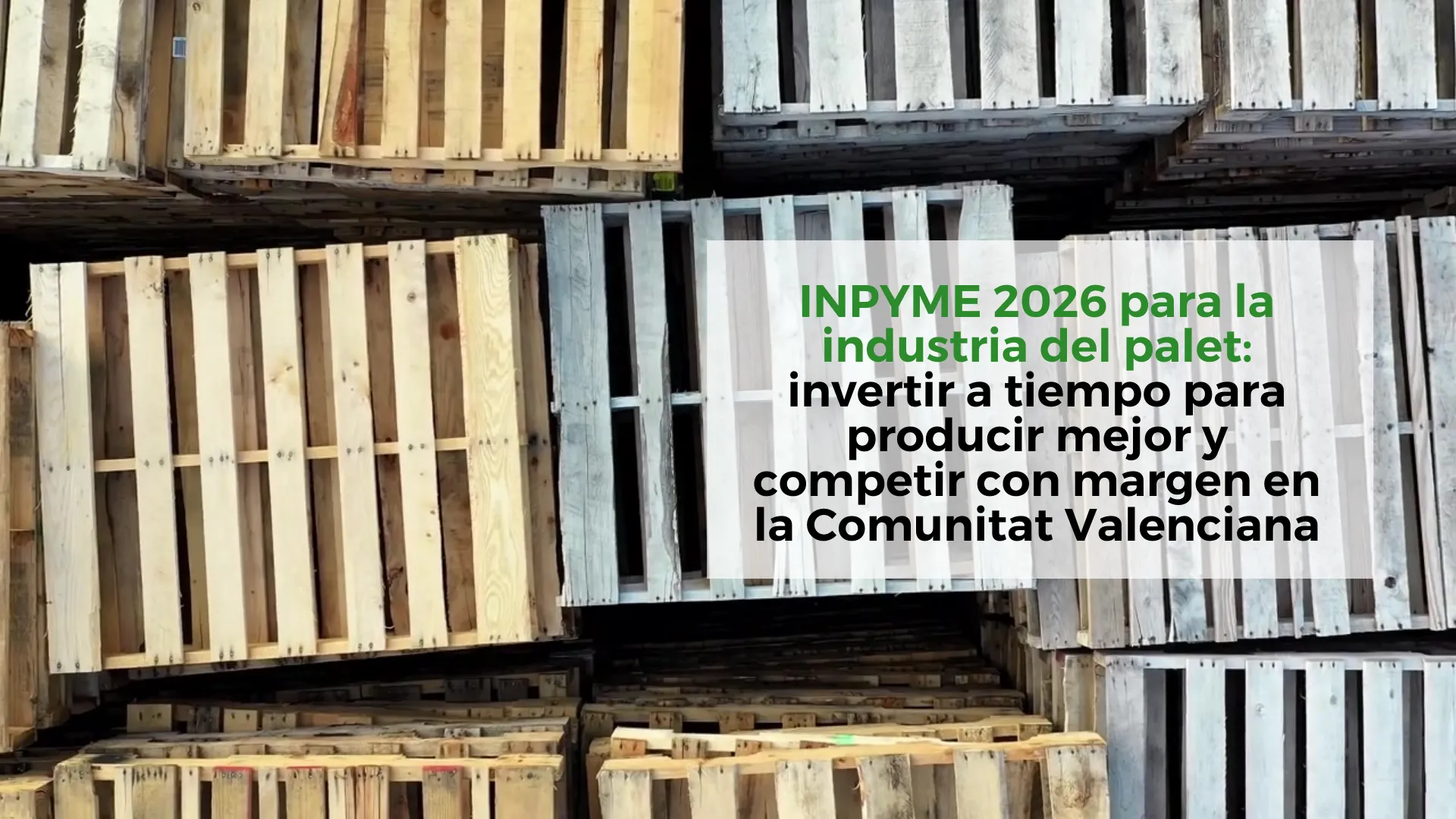
The INPYME 2026 Grants have already been published and open a real opportunity to modernize the pallet industry in the Valencian Community. With an application period from 16/02/2026 to 10/03/2026 and a competitive selection procedure, the key is to submit a solid project. In a sector where margins are won on the shop floor (wood waste, downtime, quality variability, stacking and lead times), INPYME 2026 can support investments in machinery, automation and digitalization to stabilize the process, reduce scrap and produce with higher performance and reliability.
By Ana González, CEO and Agricultural Engineer – Industrial Consultant in energy efficiency and grant management at AGB Ingeniers
Something curious happens in many pallet factories: the product is essential for the economy to move, yet its role is so silent that it is sometimes only valued when it is missing. The pallet supports exports, feeds logistics chains, absorbs seasonal peaks in agri-food, ceramics, chemicals and distribution, and keeps warehouses running at pace. And yet, the pallet industry is under constant pressure: more demanding customers, faster deliveries, tighter prices, less tolerance for variability, and a growing need to demonstrate control, traceability and responsiveness.
In this scenario, the publication of the INPYME 2026 Grants in the Valencian Community arrives at a particularly timely moment for the sector. Not because it is “just another” grant, but because it opens a short window —from 16/02/2026 to 10/03/2026— to turn necessary investments into well-structured projects that improve real productivity. In addition, this is a competitive selection process, which changes the approach completely: here, the winner is not the one who rushes on the last day, but the one who submits a coherent, well-built file with true industrial logic.
At AGB Ingeniers we have spent years supporting Valencian industrial SMEs in preparing investments and managing grants. And if there is one thing I have learned working side by side with management, production and maintenance teams, it is that a call like the INPYME grants is not taken advantage of by “asking”. It is taken advantage of by planning, defining the scope properly, preparing documentation in advance, and clearly explaining what the investment improves and how it will be proven. In the pallet industry, where margins are built on the shop floor, that clarity is the difference between driving a productive leap… or ending up with a project that doesn’t compete.
A grant that fits pallet logic: reindustrializing means making the process more stable
INPYME 2026 was created to support industrial investment in the Valencian Community with a significant overall budget (€49.3M) and a fully online application process. It is under the de minimis regime, which requires reviewing accumulated aid history, but it also offers a clear opportunity: modernize facilities to produce with more control, less variability, and greater ability to deliver.
In pallets, this translates into a very concrete idea: competitiveness doesn’t depend only on producing more, but on producing better. Better means less wood waste, fewer reworks due to out-of-tolerance dimensions, fewer incidents due to poor stacking, fewer stops caused by micro-failures, less downtime during changeovers, and more consistency to serve customers who compare suppliers by reliability, not promises.
That is why, when a pallet company invests with vision, it rarely does so on a whim. It does so because it needs to stabilize its process. And the INPYME 2026 grants, as they are designed, allow you to propose investment projects that address the points that truly transform a plant: modernization and expansion, automation, digitalization and even productive diversification, as long as everything has industrial coherence and is documented correctly.
The pallet sector and its real levers for improvement in 2026
If we look at a pallet plant through an engineering lens, the same critical points almost always appear. The first is the raw material: wood, or the base material, conditions quality, moisture, deformations, rejects and productivity. The second is the process: cutting, nailing, assembly, handling, stacking and dispatch. The third is control: how much is measured, what is recorded, how corrections are made, and what is learned from each deviation. And the fourth is internal logistics: the flow of parts and pallets through the plant can be an ally… or the biggest thief of time.
In this environment, an investment that truly changes a pallet factory is usually linked to process reliability. Modernizing key equipment is not “changing for the sake of changing”; it is gaining repeatability, reducing manual adjustment, and making quality a consequence of the system rather than a battle each shift. Automating critical operations is not “adding robots”; it is reducing variability, improving safety, and freeing the human team for value tasks: supervision, preventive maintenance, quality control and continuous improvement. Digitizing control is not “putting up screens”; it is having useful data to decide: performance by line, root causes of stoppages, material consumption, scrap by reference, recurring defects and shift patterns.
And, in addition, pallets have a particularly profitable territory: utilization. In a tight market, waste is margin that escapes. Optimizing cutting, classification, recovery, reuse and waste valorization does not only improve unit cost: it stabilizes supply, reduces purchasing dependence, and strengthens positioning with customers who increasingly ask for real sustainability, not just messaging.
The key to INPYME 2026 is not “what you buy”, but “how you turn it into a project”
Because the call is competitive, the value is not in saying “I’m going to invest.” It is in explaining with industrial logic what problem you solve, what solution you implement, and what results you will obtain. And here, in the pallet sector, it pays to be very specific: if the goal is to increase capacity, you must show where the bottleneck was and why the investment eliminates it. If the goal is to reduce scrap or rework, you must link it to a point in the process that currently generates defects. If the goal is to improve lead times, you must demonstrate how flow and line availability will change. If the goal is digitalization, you must explain which variables will be measured and how they will be used to control the process.
The administration is not inside your factory, and that is why the application file must work as a faithful translation of your productive reality. In an SME, this is the most underestimated point: the company knows perfectly well what it needs, but it has not always turned it into a defensible document, with technical coherence and documentary traceability. And in a public grant, that translation decides.
In addition, because the process is 100% online and the deadline is short, documentary order is essential. Quotes, technical reports, accreditations, coherence between concepts… everything must match from the start, because an error in a competitive environment is not only a delay: it can mean losing points, triggering requests for clarification, or leaving the file out of pace.
The message for the sector: in pallets, improvising is expensive
If you ask me what the most useful advice is for a pallet SME with the INPYME 2026 Grants, I would summarize it like this: don’t improvise the investment as if it were only a purchase. Treat it as a complete industrial project. Define the scope clearly, align the investment with a measurable goal, and prepare the documentation from day one. In this sector, where everything is connected —raw material, process, quality, logistics and lead times—, a holistic view is what turns a grant into real competitiveness.
At AGB Ingeniers we work precisely with that approach: helping an investment make industrial sense, be defensible in the application file, and be executed with guarantees. If your pallet company in the Valencian Community is considering investing in 2026 to modernize, automate, digitize or improve process, this is the time to structure it intelligently. The call has already been published and the clock is ticking. The good news is that, when the project is well planned, the leap is felt where it matters: on the line, in unit cost and in the ability to compete with margin.