
News
FEADER and Energy Efficiency in the Fruit and Vegetable Sector: The Best-Fit Investments for Citrus Processing
- 30/03/2026
- Energy Efficiency Grants
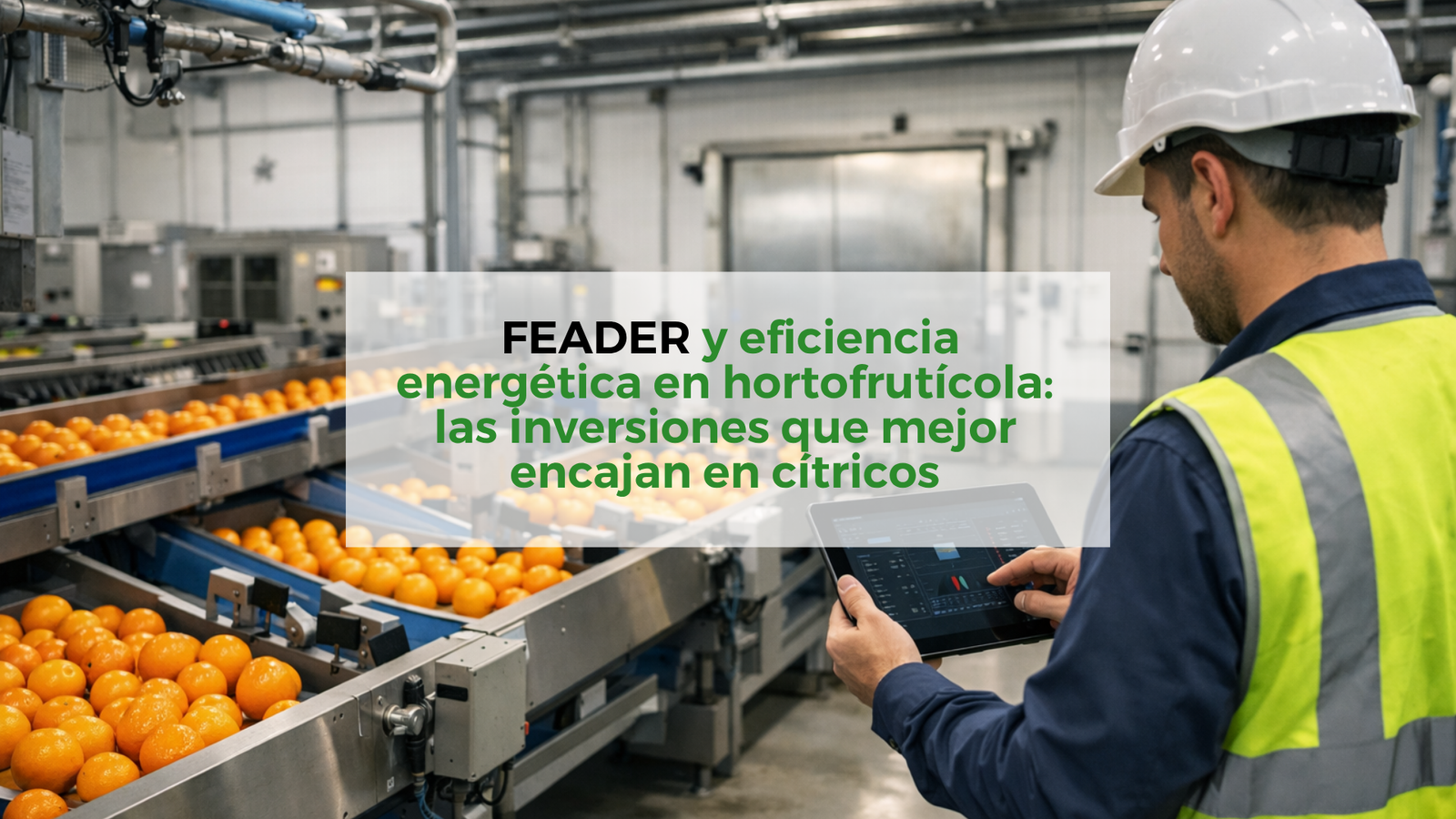
In a fruit and vegetable packinghouse, energy is not a fixed cost: it is a factor that determines margin, stability, and service capacity at peak season. That is why, when we think about FEADER in the Valencian Community, it makes sense to first look at where energy is really being consumed and which investments tend to fit best to achieve real savings: optimized industrial refrigeration, compressed air, demand-based control on lines, high-efficiency motors, and energy monitoring. Even if the call has not yet been published, preparing these actions in advance is what allows you to compete with real chances when it becomes active.
In one sentence: in citrus, the best-fit FEADER investments for energy efficiency are those that reduce consumption without compromising quality: optimized industrial refrigeration, controlled compressed air, efficient drives/motors, energy monitoring and, when appropriate, properly sized self-consumption.
By Ana González, CEO and Agricultural Engineer – Industrial consultant in energy efficiency and grant management at AGB Ingeniers
In a citrus fruit and vegetable packinghouse, energy is not just another cost. It is a variable that determines margin, service capacity, and operational stability. Many companies experience this every season: you can have excellent fruit, a strong customer base, and an experienced team, but if energy consumption spikes, or if the process is not stable, profitability fades away without making any noise. Electricity and heat don’t warn you; they simply show up on the bill, month after month, and almost always at the worst possible time.
In the Valencian Community, where fruit and vegetable production and citrus set the pace for many regions, this energy-focused perspective is especially relevant.
That is why, when we talk about FEADER, a program that supports investments in rural and agri-industrial environments and typically requires technical coherence, documentary traceability, and measurable results, and about investment opportunities in agri-industry, energy efficiency in the fruit and vegetable sector should not be seen as an “extra.” It should be seen as a competitiveness lever. And in citrus, where washing, grading, sorting, packing, labeling, cold rooms, pre-cooling, and intensive internal logistics coexist, there are investments with a particularly natural fit because they address exactly what consumes the most and what most conditions operations.
At AGB Ingeniers we have learned that true success is not about making a list of equipment. It is about building projects with shop-floor logic, that can be technically justified, and that generate real and sustainable savings. And if there is something that makes sense to work on before any call is published, it is precisely this: identifying which investments deliver return, how they integrate into the process, and how results will be measured. Because energy efficiency, when approached with method, is not a speech; it is an indicator.
The great silent consumer in citrus: industrial refrigeration and thermal stability
If there is an “energy heart” in a fruit and vegetable plant, it is industrial refrigeration. Cold rooms, tunnels, pre-cooling, conditioned areas, condensation and evaporation, compressors, ventilation, defrost cycles… All of this runs many hours and, in season, at full load. And unlike other consumptions, refrigeration does not allow improvisation: if it falls short, quality suffers; if it is oversized or poorly controlled, consumption skyrockets.
The investments that tend to fit best in an efficiency project for citrus are those that improve system performance without compromising quality. I’m not only talking about “replacing a unit,” but acting on what truly generates savings: improving demand-based control, adjusting temperatures and schedules with operational logic, adding variable speed where it makes sense, optimizing the real operation of compressors and fans, reducing thermal losses at doors and enclosures, and correcting imbalances that become chronic over time. In many plants, consumption doesn’t spike because of a single big cause, but because of accumulated small energy leaks: doors opening more than necessary, infiltrations, aged insulation, dirty evaporators, poorly adjusted defrost cycles, or setpoints maintained “out of habit.”
In citrus, well-designed energy efficiency in refrigeration is not measured only in kWh. It is also measured in product stability, lower loss, fewer alarm-related stoppages, better responsiveness, and greater peace of mind during peak season.
Compressed air: the invisible utility that costs more than it seems
Another common reality in fruit and vegetable operations is that compressed air becomes an “accepted” cost without anyone looking at it head-on. And yet, few things are as profitable to fix as an oversized air system with leaks, excessive pressure, or poor control.
On citrus lines, air is everywhere: actuators, ejection, packing, labeling, pneumatic control… The problem is that many plants run at higher pressures than necessary “just in case,” and that “just in case” is paid for every single day. A small pressure reduction, when technically feasible, can translate into continuous savings. And if leaks are also corrected —which in practice almost always exist— the payback is even faster.
The best-fit investments usually combine generation improvements (more efficient or better-sized equipment), demand-based control, and network improvements. But above all, they share one thing: they are built on a real diagnosis. At AGB Ingeniers we often say compressed air is managed better when you stop seeing it as “a compressor” and start seeing it as “a complete system.” Because an efficient compressor connected to a leaky network is still a high cost.
Motors, variable speed drives, and demand-based control on fruit and vegetable lines
The citrus industry is movement-intensive: conveyors, elevators, rollers, fans, pumps, brushes, graders, washers… Many of these loads do not need to run at 100% all the time. And that is one of the clearest efficiency opportunities: demand-based control.
When variable speed drives are added or motors are upgraded to higher efficiencies at strategic points, savings don’t come only from “a better motor.” They come because the process stops operating in fixed mode. It starts adapting to real load. In season, that adaptability is gold: the plant does not always run at the same pace, and having the ability to modulate avoids unnecessary consumption, reduces wear, and stabilizes operations.
In addition, in citrus, process control and energy efficiency overlap. A more stable line, with fewer micro-stops and better synchronization, consumes less per unit produced. In other words, you don’t just reduce kWh; you improve productivity and unit cost.
The layer that sustains everything: energy monitoring and measurement
There is a mistake I see repeated: investing in efficiency and then not measuring. In fruit and vegetable operations, where the season has peaks, shift changes, and product variability, measurement is the only way to know whether savings are real and whether they are maintained.
That is why the best-fit projects tend to include, in one way or another, energy monitoring. Measurement by panels, submetering by lines or utilities, simple but useful dashboards, deviation alarms, comparison by shifts or by production days. Not to “fill screens,” but to manage.
And this has a very important consequence: when a company measures, it doesn’t just save. It learns. It detects idle consumption, identifies patterns, corrects deviations before they become structural cost, and can justify results with data. In any grant line, that ability to prove improvement is often an advantage. But even without a call, it is the foundation of real efficiency.
“Measure to save” in citrus is usually based on: consumption per panel/line, associated production, and comparison by season/shift to detect deviations.
Self-consumption: when it helps and when it doesn’t
In citrus, photovoltaic self-consumption can make sense, but only when it is integrated with the real consumption curve. Many plants have significant daytime consumption, especially when activity is intense. But the mistake is to treat it as “the solution” without first doing the efficiency work.
My approach is always the same: first reduce what doesn’t add value, stabilize the process, and correct inefficiencies; then size generation. Because a more efficient plant needs less energy to produce the same output, and that completely changes the optimal sizing of self-consumption.
FEADER: why it makes sense to work on these investments before the call is published
Even if FEADER has not yet been published, smart work starts earlier. A strong fruit-and-vegetable energy-efficiency project is not built in a week. It is built by identifying where consumption is, where waste is, which actions make sense, and how they will be measured.
At AGB Ingeniers we support companies to do exactly that: turn an investment need into a defensible project, with shop-floor logic and technical coherence. In citrus, where competitiveness is decided by stability, quality, and costs, energy efficiency is not a “nice-to-have.” It is a strategic lever.
If your fruit and vegetable packinghouse in the Valencian Community is considering improvements in industrial refrigeration, compressed air, motors, control, or monitoring, this is a good time to organize it calmly. Because when the call arrives, the important thing won’t be to rush. The important thing will be to be prepared.
Frequently asked questions about FEADER and energy efficiency in citrus
Which energy-efficiency investments are usually most profitable in a citrus packinghouse?
They are usually those that target continuous consumption and process variability: optimization of industrial refrigeration (demand-based control, variable speed drives, setpoint adjustments, and thermal losses), reducing leaks and pressure in compressed air, adding high-efficiency motors and drives on lines, and energy monitoring to detect deviations. These are actions that reduce kWh without compromising quality or the pace of the season.
Why is industrial refrigeration often the main energy consumer in fruit and vegetable operations?
Because it runs many hours and at high load during the season: cold rooms, tunnels, pre-cooling, ventilation, and defrost cycles are continuously active. In addition, small accumulated inefficiencies (doors, infiltrations, insulation, dirty evaporators, or poorly adjusted control) translate into constant consumption. In citrus, maintaining stable temperature is part of the product, and that makes refrigeration the plant’s “energy heart.”
How do you prove energy savings in a project (before and after)?
By comparing a baseline (previous consumption) with post-project consumption, normalizing by operating variables such as tons processed, operating hours, shifts, and seasonal conditions. The most robust way is to measure by panels/utilities or submetering by lines, and to complement it with production records and process parameters. Without before-and-after data, savings remain an estimate; with measurement, they become evidence.
Is it better to start with self-consumption or with efficiency?
In most cases it is best to prioritize efficiency first and self-consumption afterwards. Reducing losses in refrigeration, compressed air, and motors lowers structural consumption and allows self-consumption to be sized more precisely. Self-consumption helps when it matches the real daytime consumption curve, but if the plant carries inefficiencies, there is a risk of “generating to waste.”
When should you prepare the project if the call has not yet been published?
Now, before it is published. Preparing early makes it possible to define scope, gather coherent quotes, organize the technical side, and plan how savings will be measured. When the call becomes active, the company doesn’t improvise: it submits a solid, competitive project. With grants, the margin of success is usually in anticipation and in the quality of the file, not in rushing at the end.