
News
Emergency Plan for High-Risk Companies: Safety, Operational Continuity, and Compliance Without Improvisation
- 18/05/2026
- Innovation
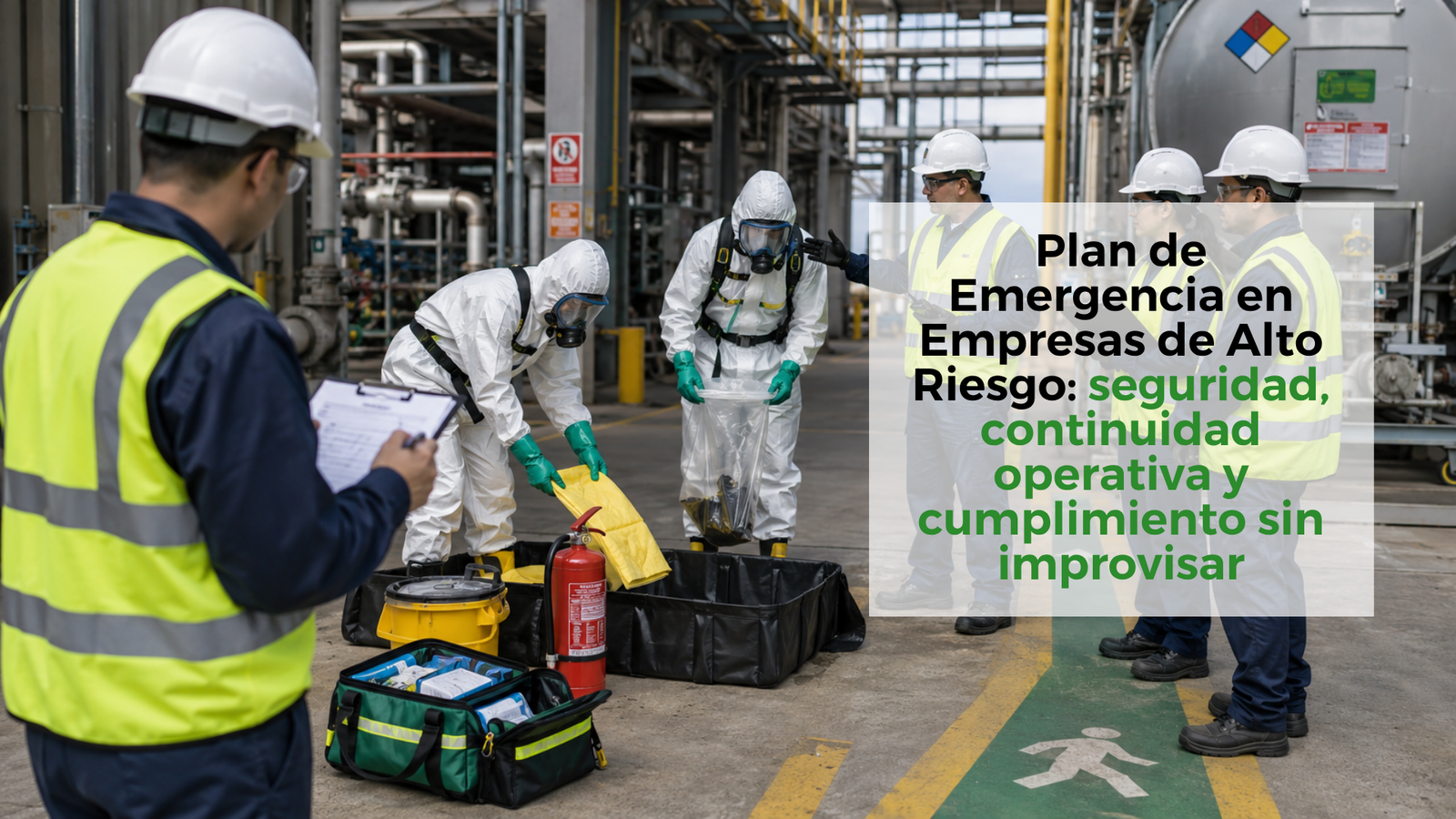
In companies that work with hazardous materials or high-risk processes, an Emergency Plan is not a formality: it is the difference between a controlled incident and a crisis with downtime, damage, and liabilities. In this post I explain what is considered high risk, how it translates to the agri-food industry, and why method matters: risk diagnosis, regulatory fit, operational drafting, implementation, drills, and updating. Because in safety, improvisation is always expensive.
By Ana González, CEO and Agricultural Engineer – Industrial consultant in energy efficiency and grant management at AGB Ingeniers
In a company that works with hazardous materials or high-risk processes, there is a truth that allows no nuance: on the day an incident happens, “paper” doesn’t protect you. What protects you is what the company has thought through, trained, and is ready to execute. That’s why I like to start with a strong, very real message: in high-risk environments, the Emergency Plan is not a document; it is operational continuity, safety, and compliance.
And I say it from experience. Because when an industry operates with APQ (stores chemical products), hazardous substances, potentially explosive atmospheres, gases, solvents, sensitive storage, or processes where a failure becomes a crisis, the Emergency Plan becomes a “defense system” for the business. It doesn’t only protect people. It protects the facility, reduces the impact of a shutdown, limits material damage, prevents escalation, improves response in audits, and strengthens the relationship with insurers and public authorities.
At AGB Ingeniers we work with that logic: we don’t create “plans to comply.” We build plans that work. And when a plan works, in addition to protecting, it complies.
In one sentence
An Emergency Plan for high-risk companies must turn accident scenarios into clear procedures, real resources, trained roles, and verifiable evidence.
Hazardous materials and high-risk companies: from chemical risk to the agri-food reality
When we talk about hazardous materials, we mean substances or products that, by their nature, can cause serious harm if they are released, mixed, or managed incorrectly. In industry this includes, for example, flammables (solvents, certain fuels), corrosives (acids and bases), toxics (products that affect by inhalation or contact), oxidizers (which accelerate combustion), reactives (which can decompose or react violently), or pressurized gases. This is not a theoretical label: it’s an operational reality that requires proper storage, clear compatibility rules, ventilation, containment, protective equipment, and emergency procedures. In many cases, these materials are also regulated by specific storage and safety regulations, and their presence directly conditions how the Emergency Plan must be prepared.
A high-risk company is not high risk only because it “has chemicals.” It is high risk because, in the event of an incident, there is a real possibility of a major accident: a rapidly spreading fire, explosion, toxic cloud, spill with environmental impact, uncontrolled reaction, or critical shutdown with safety consequences. High risk appears when hazardous substances are combined with volume, process energy, pressure, temperature, frequent handling, or environments where a small deviation can escalate. And that’s where the Emergency Plan stops being a “prevention” document and becomes an operational continuity system: it determines response times, containment, evacuation or shelter-in-place, coordination with external services, and evidence of control in audits and inspections.
In the agri-food industry, this approach also applies, even if it isn’t always perceived the same way. A fruit-and-vegetable packinghouse, an IV/V range facility, a winery, or an olive mill may operate with hazardous materials without calling them that: cleaning and disinfection chemicals, detergents and biocides, refrigerant gases, pressurized gases, fuels, lubricants, or APQ storage associated with industrial hygiene. In addition, operations themselves include high-impact risks: cold rooms and industrial refrigeration, demanding electrical installations, boilers, dusty atmospheres, moving machinery, and peak-season spikes where any incident can paralyze the plant. That’s why, in agri-industry, working on an Emergency Plan with a high-risk mindset is not exaggeration: it’s protecting people, product, continuity, and reputation.
The most expensive mistake: believing that “having a plan” means having response capability
Many companies “have a plan” because it was drafted at some point. But in high-risk environments, what matters is not having it: it’s that the plan is aligned with the current reality of the plant and that it is operational. A company changes more than it thinks: it increases storage, introduces reagents, changes layout, expands lines, adds equipment, modifies shifts, outsources maintenance, changes suppliers, or introduces new internal routes. And if the plan doesn’t keep up with that evolution, the document becomes an old photograph.
When an inspection, an audit, or an incident arrives, that disconnect is paid for. And it is paid for in the form of doubts, late decisions, confused communications, improvised actions, or procedures that don’t match what actually exists in the plant. In high risk, improvisation is not a nuisance: it is a problem multiplier.
What “high risk” means in practical terms
We don’t need to go into regulatory detail today (because each company and activity fits into different frameworks), but it’s worth understanding the idea: high risk means that if something happens, there may be serious impact on people, facilities, or the environment.
In these types of companies, the Emergency Plan is built around real scenarios: chemical spill, gas leak, fire involving incompatible substances, uncontrolled reaction, explosion, hazardous atmosphere, toxic cloud, containment failure, critical electrical failure, etc. And, very importantly, it defines what to do in each case, because not everything is solved by evacuating. In certain scenarios, shelter-in-place is safer than evacuation. In others, rapid evacuation is the only way out. That decision cannot be made in minute zero of an incident. It must be planned and trained.
A working Emergency Plan shows up in six things
When I review a plan and I know it’s well developed, I almost always find these six signals:
First, it knows the real installation. Not the ideal one. The real one: areas, risks, storage points, incompatibilities, routes, access, equipment, utilities, shifts, and contractors.
Second, it translates risk into scenarios. It doesn’t stay at “possible emergencies”; it describes what can happen, where, with what consequences, and what response applies.
Third, it assigns roles and decisions. Because in an emergency it’s not “the company” that decides: a structure decides. Who triggers the alarm, who cuts supplies, who calls external emergency services, who leads intervention, who manages evacuation or shelter-in-place.
Fourth, it connects procedures to resources. It’s not enough to say “contain a spill” if there are no kits, suitable PPE, correct absorbents, training, and a clear safety criterion.
Fifth, it tests the plan. Drills and exercises not as theater, but as verification: timings, communication, failures, improvements.
Sixth, it updates. Because a living plan is reviewed, corrected, and adapted when installations, substances, processes, or the human structure change.
The AGB method: from diagnosis to real implementation
At AGB Ingeniers, when we work on Emergency Plans for high-risk companies, we follow a clear method. And we do it this way because it is the safest way to achieve two things at once: that the plan works and that the plan complies.
1) Real risk diagnosis
We start by understanding the plant and its activity: what is handled, how much, where, how it moves, which risks dominate, and which installations support the process (fire protection systems, ventilation, detection, containment, storage, etc.). Here we identify the key point: where an incident could start and how it could escalate.
2) Regulatory fit
Not all companies fall under the same framework of obligations, and this is where mistakes are avoided: self-protection, internal emergencies, chemical storage, sector requirements, customer audits, insurer requirements. Regulatory fit is not a “chapter”; it is the map that ensures the plan covers what it must cover.
3) Operational drafting
The drafting is not done to “fill pages.” It’s done so that the people who will execute it understand it: managers, shifts, contractors, maintenance, production. We include clear procedures, routes, critical points, resources, and internal/external communication.
4) Implementation
This is the difference between a document and a tool. Implementing means training, assigning teams, defining assembly points, signage, verifying resources, organizing kits, validating PPE, and leaving everything ready to be used without doubts.
5) Drills that matter
A high-risk drill cannot be generic. It must match a realistic scenario and measure something: alarm times, evacuation or shelter-in-place times, team response, communication failures, blocking points. A drill is not meant to “look good”: it’s meant to improve.
6) Updating
The plan is reviewed when the plant changes. And it is also reviewed periodically. Because high risk does not forgive outdated documents.
Why this approach also improves audits and insurance
This matters. Many companies come to the Emergency Plan out of obligation, but later discover the benefit is greater: a well-implemented plan reduces exposure and demonstrates control. That carries weight in audits, due diligence, certifications, and also in the relationship with insurers. When a company has evidence (training, drills, reviews, maintenance, and documentary coherence), it stops looking “vulnerable” and starts looking “managed.”
At AGB Ingeniers we specialize in Emergency Plans for High-Risk Companies and apply the same methodology to all types of industries, including agri-food and fruit-and-vegetable operations. If your company works with hazardous materials, APQ, or critical processes, we help you turn the plan into a real tool: diagnosis, regulatory fit, operational drafting, implementation, drills, and updating.
If you want to know whether your industry is truly prepared, contact us and we’ll review your case.
Frequently asked questions (AEO)
What is an Emergency Plan for companies with hazardous materials?
It is a response system that defines scenarios, roles, procedures, resources, and communication to act in incidents involving chemical risk, fire, leaks, explosions, or high-impact events.
Are an Emergency Plan and a Self-Protection Plan the same?
Not necessarily. In many companies they are integrated or overlap, but the Self-Protection Plan tends to have a more formal scope depending on the activity, and the Emergency Plan focuses on operational response. The key is that the applicable document is aligned with the real risk and with the required framework.
Do you always have to evacuate?
No. In certain scenarios (for example, some hazardous-atmosphere episodes), shelter-in-place can be safer than evacuation. That’s why the decision must be scenario-defined and trained.
How often should the plan be reviewed?
Whenever the installation, storage, process, or organization changes; and, in addition, at a defined periodicity to ensure it remains valid, operational, and known by the teams.
What does AGB Ingeniers bring to these plans?
A complete method: risk diagnosis, regulatory fit, operational drafting, real implementation, useful drills, and updating so the plan works and can be demonstrated.