
News
Traduce al inglés: No toda inversión eficiente es subvencionable: cómo preparar correctamente un proyecto IVACE 2026
- 18/08/2026
- Aids
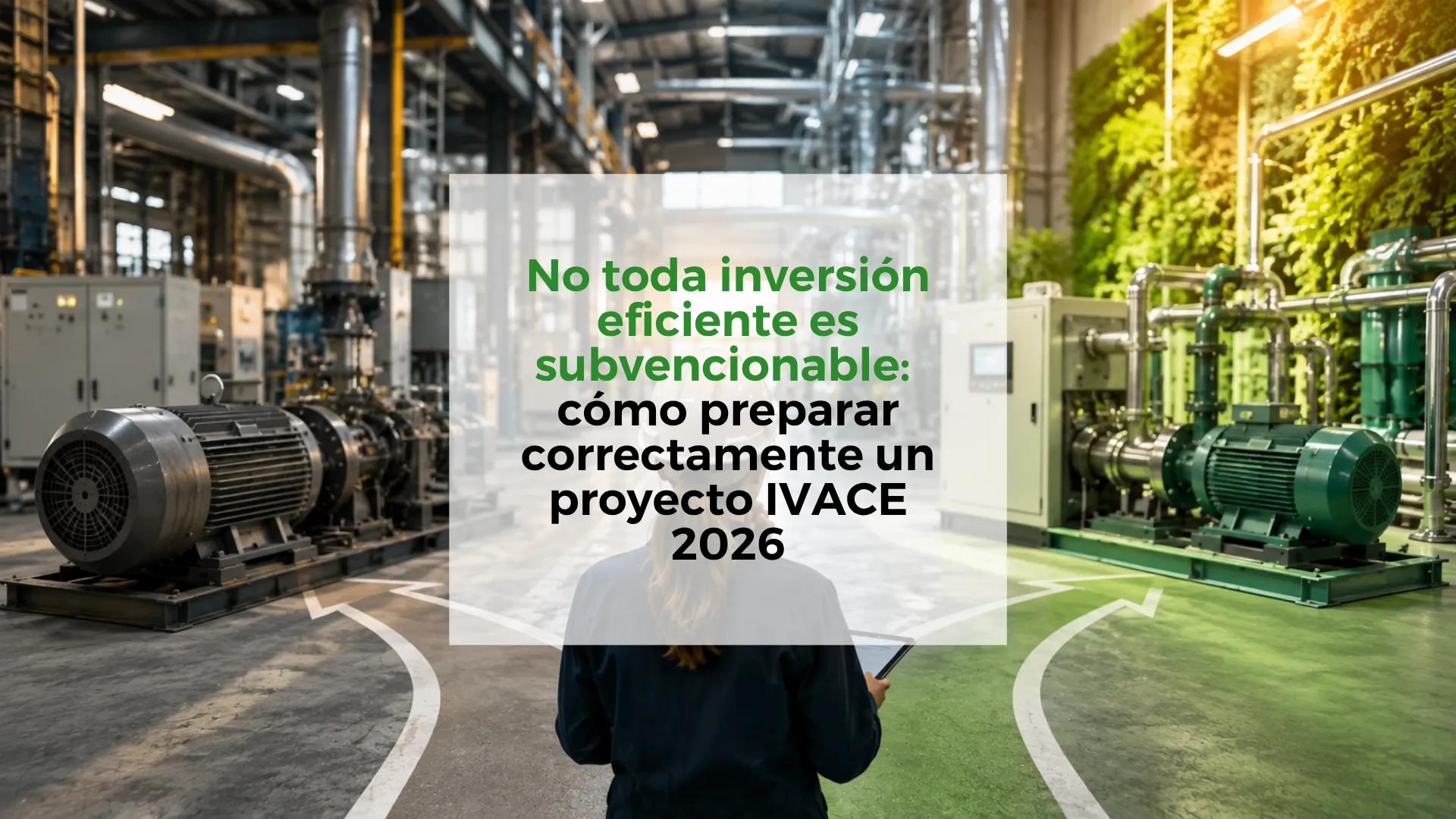
The IVACE 2026 grants can support investments aimed at reducing the energy consumption of companies in the Valencian Community. However, replacing a machine with a newer or more efficient one does not automatically make the project eligible for funding. The company must demonstrate energy and emissions savings, distinguish the energy efficiency improvement from an ordinary replacement, and correctly justify which part of the investment is directly linked to efficiency.
By Ana González, CEO and Agricultural Engineer – Industrial consultant in energy efficiency and grant management at AGB Ingeniers
In many of the conversations I have with companies in the Valencian Community, an apparently logical idea is repeated: «We are going to replace this machine with a new one that consumes less energy, so the investment should qualify for the IVACE 2026 grants».
However, the answer is not always that simple.
The fact that new equipment is more efficient than the existing one is a good starting point, but it does not in itself guarantee that the entire acquisition cost will be eligible for funding. For a project to fit within the call, it must have a clear energy-related purpose, produce quantifiable energy savings and CO₂ emissions reductions, and provide documentary evidence of those results. In addition, it must comply with the technical, economic and time-related conditions established by IVACE.
In my experience, this is one of the aspects that should be analysed most carefully before requesting final quotations, accepting an order or making an investment decision. The question should not only be how much energy the new machine consumes. We must also ask what is being replaced, why the investment is being made, what the conventional alternative would be and what proportion of the cost genuinely corresponds to achieving a higher level of energy efficiency.
What turns an investment into an energy efficiency project?
An investment can be considered an energy efficiency project when its main objective is to reduce consumption and emissions compared with an initial situation or a reference alternative, and those savings can be calculated and technically justified.
The IVACE 2026 call includes, among other actions, the replacement of process and auxiliary equipment, waste heat recovery, the incorporation of efficient motors and variable frequency drives, improvements to refrigeration installations and the implementation of energy measurement, management, automation and control systems. The equipment purchased must be new.
In an agri-food industry, for example, actions could be considered involving:
- refrigeration plants;
- air compressors;
- pumps and motors;
- ventilation systems;
- washing, processing or packaging lines;
- heat recovery;
- monitoring and control systems.
These same possibilities also apply to companies in other industrial and economic sectors in the Valencian Community, provided that the project meets the requirements of the call.
What matters is not the sector itself, but the existence of a genuine and demonstrable energy improvement.
The initial situation must be clearly defined
To calculate savings, we need to know our starting point.
When we study an existing installation, we analyse the equipment’s energy consumption, operating hours, associated production, power, actual workload and the conditions under which it operates. It is not enough to compare the technical specifications of two machines and use the difference between their rated power values.
A lower-powered machine may operate for more hours. A new compressor may have high efficiency but operate inefficiently if the pressure is not correctly adjusted. A refrigeration system may offer a significant theoretical improvement that is later reduced if temperatures, thermal demand or the seasonal profile are not properly taken into account.
For this reason, the calculation must be related to the company’s actual operating conditions.
The call establishes a minimum economic-energy ratio of 150 toe per million euros of eligible investment, expressed as annual primary energy savings relative to the investment. This means it is necessary to verify that there is a sufficient relationship between the project cost and the savings achieved.
The key concept: the reference investment
One of the most important aspects of the IVACE 2026 grants is determining the eligible cost.
When an action is intended exclusively to improve energy efficiency and there is no reasonable less efficient alternative, the eligible cost may correspond to the entire eligible investment.
However, in many projects there is a reference alternative.
Imagine that a company needs to replace a machine because it has reached the end of its useful life. It can choose a conventional model costing 100,000 euros or a high-efficiency solution costing 130,000 euros. In this case, the call may consider that the cost directly related to the energy improvement is the difference between the two alternatives, in other words, the additional 30,000 euros, and not necessarily the full 130,000 euros of the investment.
The reference must be technically credible. The aim is not to deliberately look for the cheapest option on the market, but to identify what investment the company would reasonably have made without the grant and compare it with the higher-efficiency solution.
IVACE also allows costs to be determined without identifying a counterfactual scenario. In this case, the costs directly linked to achieving a higher level of efficiency may be considered, but the applicable aid intensity is reduced by 50%.
This distinction can significantly change the expected amount of aid and should be studied before submitting the application.
Replacing, maintaining and saving energy do not mean the same thing
Another common mistake is to present as energy efficiency an action that in reality primarily responds to a need for maintenance, conservation or ordinary replacement.
The call excludes actions carried out for maintenance or conservation purposes, even if they generate some energy savings. Investments mainly intended to increase production capacity and new production installations are also excluded, except in certain cases involving the replacement of existing installations. When the increase in capacity exceeds 10%, only the proportional part linked to the capacity being replaced may be eligible.
This does not mean that an old machine cannot be replaced through an eligible project. It means that the following elements must be correctly separated and justified:
- the replacement required to continue production;
- the possible increase in capacity;
- and the additional investment associated with the energy efficiency improvement.
In engineering, a single action can respond to several needs. The technical report must distinguish them clearly.
What other investments are excluded from IVACE 2026?
The call does not subsidise renewable energy installations under this specific funding line. It also excludes energy equipment powered by fossil fuels, including natural gas, projects that increase their consumption, vehicles used for transporting people or goods, second-hand goods and certain air-conditioning, lighting or building-envelope projects in buildings with excluded uses.
In addition, the following are not considered eligible:
- VAT;
- financial expenses;
- in-house staff costs;
- the purchase of land or property;
- the dismantling of the existing installation;
- crane services for removing it;
- or expenses that are not directly related to energy savings.
When directly linked to the project, the following may be included: auxiliary equipment, pipes, electrical connections, valves, installation, commissioning, technical projects, site supervision, strictly necessary civil works, transport, technical assistance and certain legalisation costs. The eligible investment must exceed 10,000 euros.
The supplier’s quotation does not replace the technical report
The supplier knows its equipment and can provide very valuable information on power, performance and operating conditions. However, its quotation does not usually explain by itself how the current installation performs, what the energy baseline is or how the annual savings have been calculated.
The application must be accompanied by an energy audit or technical report, in addition to the corresponding administrative and technical documentation.
For the application to be consistent, the quotation, technical report and calculations must match in aspects such as:
- equipment characteristics and power;
- scope of the action;
- operating hours;
- initial and expected consumption;
- production capacity;
- energy savings;
- emissions reduction;
- eligible costs;
- implementation schedule.
A small contradiction can raise doubts about the entire approach. That is why, before drafting the technical report, we need to understand the reality of the installation and define precisely what will be implemented.
The investment cannot begin before applying for the grant
The incentive effect of the call requires the application to be submitted before the project begins. The action may start after the application has been registered, although doing so does not mean that the grant has already been awarded.
Therefore, before placing a binding order, signing a contract, making an initial payment or starting the work, it is advisable to review the specific conditions of the operation.
This is one of the reasons why I recommend assessing the grant during the decision-making phase and not once the machinery has already been ordered.
How can I know whether my IVACE 2026 project is properly structured?
Before submitting the application, the company should be able to answer these questions affirmatively:
- Is the project’s main objective to improve energy efficiency?
- Do we know and can we document the initial consumption?
- Have the savings been calculated using actual operating conditions?
- Can we justify a reference investment?
- Have we separated the increase in capacity from the energy efficiency improvement?
- Are the included costs directly related to the savings?
- Does the eligible investment exceed 10,000 euros?
- Has the action not yet started?
- Does the technical report match the quotations?
- Does the project meet the required energy ratio?
A negative answer does not necessarily mean that the project should be discarded. It may indicate that more data needs to be collected, the proposed solution needs to be reviewed or the investment needs to be approached differently.
Our approach at AGB Ingeniers
At AGB Ingeniers we do not begin a project simply by asking which machine the company wants to buy. First, we try to understand what problem it wants to solve, how the current installation operates and where the energy consumption actually occurs.
From there, we analyse alternatives, study the available data and determine whether the investment can be turned into an energy efficiency project that is technically and economically justifiable.
The IVACE 2026 grants can cover up to 35% of the eligible cost, with increases of ten percentage points for medium-sized companies and twenty for small companies, up to a maximum of 400,000 euros per project. However, the aid percentage only makes sense after correctly determining what the genuinely eligible cost is.
The objective is not to artificially adapt a purchase to fit a funding call. It is to identify an action that reduces consumption, improves the company’s competitiveness and can be supported by coherent data, calculations and technical decisions.
Frequently asked questions about IVACE 2026 projects
Can every new machine with lower energy consumption receive an IVACE grant?
No. It must be demonstrated that the investment produces quantifiable energy savings and emissions reductions, meets the technical requirements and has a clearly justified energy-related purpose.
Is the full price of the new machine subsidised?
Not necessarily. Where there is a conventional lower-efficiency alternative, the eligible cost may be limited to the difference between that alternative and the high-efficiency solution.
Can an expansion of production capacity be subsidised?
Investments mainly intended to increase production capacity are not eligible. In certain replacement projects involving an increase of more than 10%, only the proportional part corresponding to the existing capacity being replaced may be considered.
Can solar panels be included?
Not under this specific energy efficiency call for companies. Renewable energy projects are expressly excluded from this funding line.
When is the application deadline?
Applications can be submitted until 29 October 2026. The award criterion is the time of submission and, if the available budget is exhausted, subsequent applications may be placed on a provisional reserve list.