
News
Food Refrigeration Is Changing: How to Prepare the Valencian Agri-Food Industry for a New Era
- 24/08/2026
- Innovation
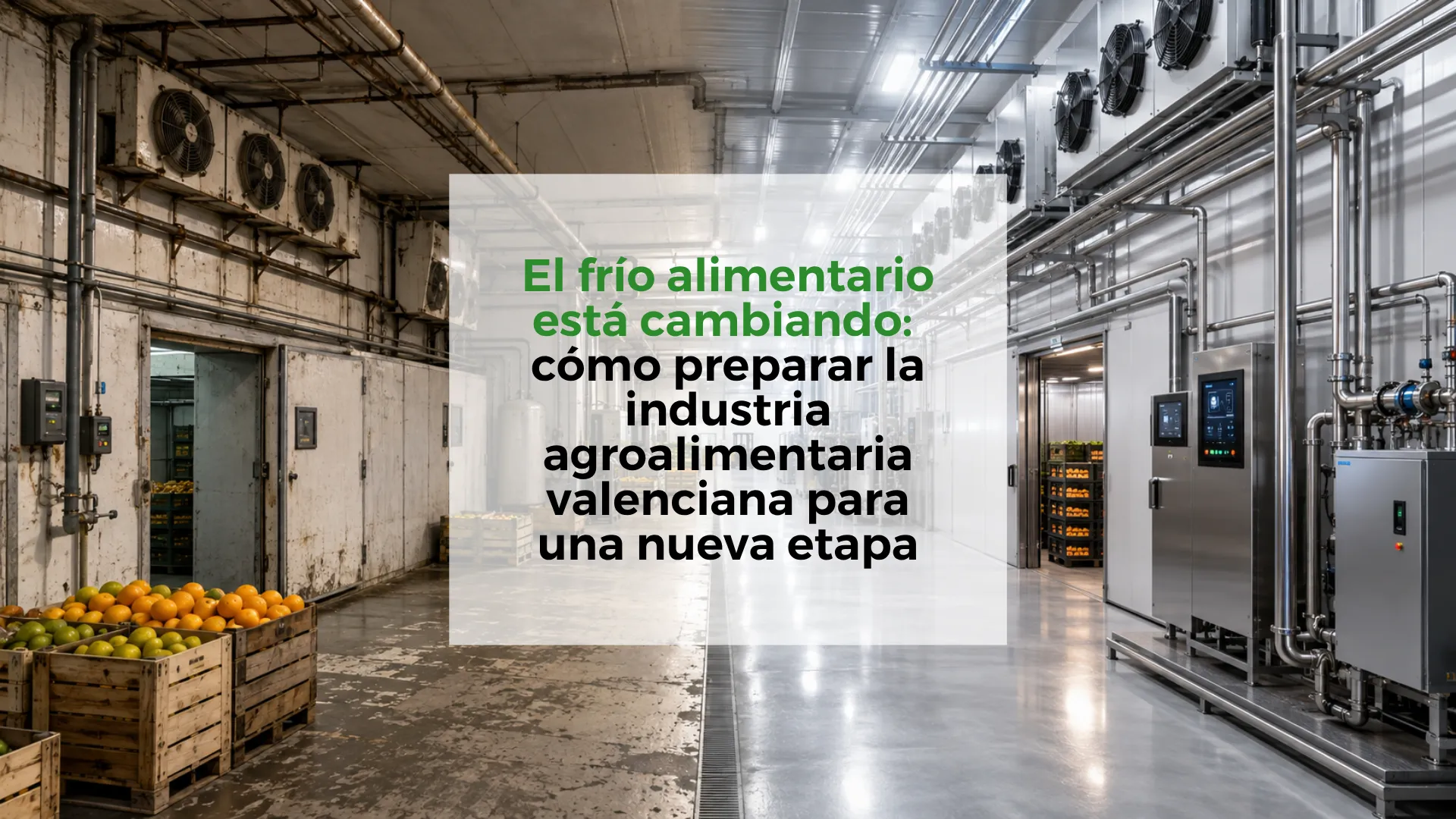
Food refrigeration is undergoing a transformation that affects energy efficiency, refrigerants, safety and product preservation as a result of new European regulations. Drawing on my experience in the agri-food industry in the Valencian Community, I analyse why this evolution must be approached with planning and sound technical judgement. It is a key issue for the future of the sector and a very interesting post: I recommend that you read it.
By Ana González, CEO and Agricultural Engineer – Industrial consultant in energy efficiency and grant management at AGB Ingeniers
When I enter a food industry facility, one of the first things I try to understand is how the product moves through the plant. I want to know the conditions in which it arrives, how long it remains stored, what transformations it undergoes and what temperature it requires at each stage. Only then does it make sense to analyse cold rooms, compressors, evaporators, piping, control systems or electricity consumption.
Industrial refrigeration is often perceived as an auxiliary service: an installation that must maintain a certain temperature and operate without interruption. However, in the agri-food industry it is much more than that. Refrigeration influences food safety, quality, texture, moisture loss, ripening, product shelf life and the continuity of production.
In addition, the sector is now facing a major regulatory and technological transformation. The new European framework on fluorinated gases is accelerating the gradual reduction of refrigerants with a high global warming potential. For many companies, the transition will not simply involve replacing one gas with another, but reviewing the entire refrigeration system.
What is changing in food refrigeration?
The answer is clear: industries will need to move towards refrigeration installations with a lower climate impact, capable of maintaining safety, energy efficiency and the specific conditions required by each food product.
For years, certain installations could be adapted through refrigerant changes and partial modifications. The current situation is more complex. The use of substances with different characteristics may require changes to compressors, valves, piping, heat exchangers, electrical controls, detection systems and safety measures.
In some projects, it will be possible to retain the cold room envelope or insulated panels, but a significant part of the production, distribution and heat exchange system will need to be reconsidered.
This turns adaptation into a strategic decision. A company should not simply ask which refrigerant it will use in the future. It should analyse what system it really needs to preserve its product, how much energy it will consume, how it will be integrated into the process and how adaptable it will be over the coming years.
Producing cold is not enough
In the Valencian Community, we work with very different agri-food activities. A fruit and vegetable processing centre operating seasonally does not require the same installation as a processing industry running three shifts a day. Nor can a cold room for citrus fruit, a cooling tunnel, a frozen-food warehouse or a processing room be designed in the same way.
In the fruit and vegetable sector, for example, temperature is only one of the variables. Relative humidity, air velocity, air renewal, storage time and the physiology of the product itself also play a role. A system may quickly reach the required temperature and still cause dehydration, weight loss or excessive differences between different areas.
In a processing industry, refrigeration may be directly linked to the production rate. A shutdown not only affects preservation, but may also force production lines to stop, alter processes or compromise products already in production.
That is why, when we work on a refrigeration installation, we cannot separate the equipment from the food product. We need to understand both.
This is precisely one of the most important contributions of agricultural engineering: interpreting refrigeration as part of a biosystem in which the product, the process, energy, people and environmental conditions all interact.
There is no perfect refrigerant for every industry
Among the alternatives gaining greater prominence are carbon dioxide, ammonia and certain hydrocarbons such as propane. These refrigerants have a very low global warming potential compared with many traditional fluorinated gases, but their properties and application requirements are different.
Carbon dioxide may be suitable for certain configurations and temperature ranges, but its performance depends greatly on design conditions and climate. Ammonia has a long history in large industrial installations and offers good performance, although its toxicity must be properly managed. Hydrocarbons can provide high efficiency, but their flammability requires charge limitations and specific safety measures.
The fact that a refrigerant involves certain risks does not mean that it is an unsafe solution. It means that the installation must be designed, installed, legalised and maintained in accordance with its classification and with the conditions established by the Refrigeration Installations Safety Regulations. These regulations are intended to protect people, property and the environment.
The choice must therefore take into account the size of the plant, refrigeration load, product, process, temperatures, location, investment, maintenance requirements and the availability of qualified personnel.
The environmental challenge cannot be separated from energy consumption
Reducing direct emissions associated with refrigerants is essential, but we must not forget the indirect emissions caused by the electricity consumed by the installation.
In some companies, refrigeration represents one of the largest energy costs. A technically valid decision regarding the refrigerant may not be the most appropriate if it forces the system to operate with excessive consumption for thousands of hours each year.
For this reason, the transformation of food refrigeration should also be used as an opportunity to study overall efficiency:
- sizing adjusted to actual demand;
- compressors with efficient control;
- condensation adapted to external conditions;
- variable frequency drives;
- heat recovery;
- improved insulation;
- rapid doors and infiltration control;
- temperature and consumption monitoring;
- preventive maintenance and early detection of deviations.
Digitalisation also makes it possible to move beyond management based solely on alarms. Measuring pressures, temperatures, operating times and electricity consumption helps us understand how the installation actually performs and detect efficiency losses before they become a breakdown or a significant increase in energy costs.
Waiting for the installation to fail is not a strategy
In many plants, the refrigeration system continues to operate and there appears to be no immediate urgency. However, certain warning signs may indicate that it is time to begin an assessment: refrigerants with a limited future, recurring leaks, difficulty sourcing spare parts, rising consumption, insufficient capacity at peak times or equipment nearing the end of its useful life.
Renovating a refrigeration installation takes time. The existing situation must be studied, the process understood, alternatives defined, loads calculated, safety measures analysed, the investment assessed and the work planned so that it interferes as little as possible with production.
In seasonal sectors, this planning becomes even more important. A fruit and vegetable processing centre cannot undertake a critical intervention just as the production season begins. The technical timetable must be coordinated with the production schedule.
My recommendation is not to wait until regulations, a breakdown or a shortage of refrigerant forces an urgent decision. A planned transformation makes it possible to compare solutions and turn a future obligation into an opportunity to reduce consumption, improve control and strengthen plant reliability.
The opportunity for agricultural engineering
Food refrigeration is currently at a point where regulation, technology, energy, safety and product knowledge converge. This combination requires professionals capable of communicating with production teams, maintenance departments, installers, suppliers and quality managers.
At AGB Ingeniers, we believe that a refrigeration installation should not be designed in isolation. It must be integrated into the real operation of the industry and respond to the needs of the food product it has to preserve.
The objective is not simply to produce cold. It is to do so safely, efficiently and with a long-term perspective.
Because behind every cold room and every pipe there is something we must never lose sight of: a living or processed product whose quality depends on all technical decisions working in the same direction.