
News
Can My Company Apply for the IVACE 2026 Grants? Ten Questions to Find Out Whether the Project Qualifies
- 01/09/2026
- Aids
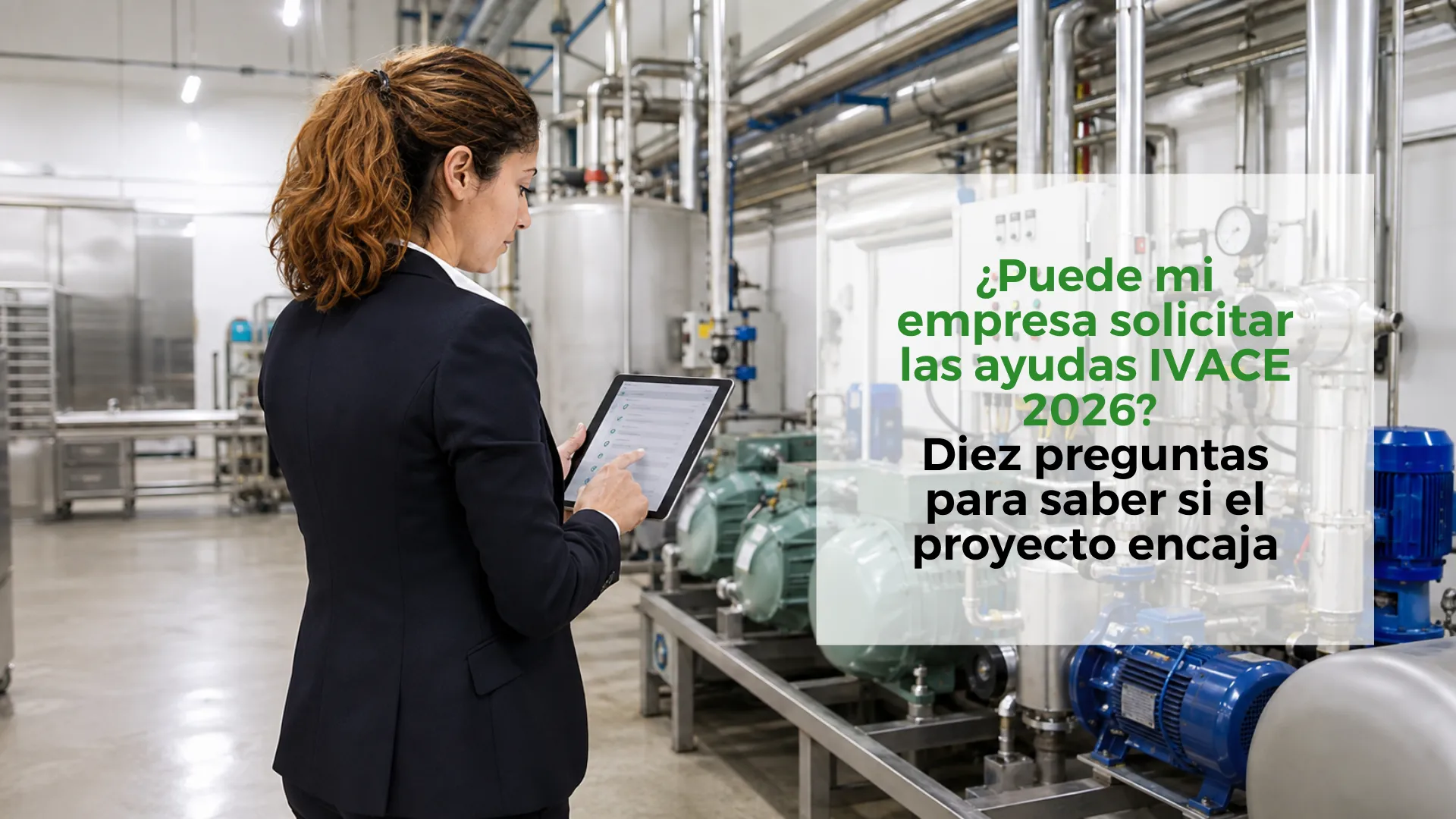
The IVACE 2026 grants support energy efficiency projects developed by companies from different sectors in the Valencian Community. To determine whether an investment may be eligible for funding, it is not enough for the new equipment to consume less energy: the energy savings, emissions reduction, eligible costs and initial situation must all be justified. These ten questions provide an initial assessment before preparing the application.
By Ana González, CEO and Agricultural Engineer – Industrial consultant in energy efficiency and grant management at AGB Ingeniers
When a company approaches us with an investment proposal, the first conversation usually begins by discussing equipment: a refrigeration plant, a compressor, a pump, a motor, a ventilation system or a new production line.
However, when we analyse the possibility of applying for the IVACE 2026 energy efficiency grants, the most important question is not which machine the company wants to buy. First, we need to understand what installation currently exists, how it operates, how much energy it consumes and what specific energy improvement the new solution will provide.
The direct answer is this: a company can apply for the IVACE 2026 grants if it carries out an action in the Valencian Community that generates quantifiable energy savings and a reduction in CO₂ emissions, meets the requirements of the call and has not started the project before submitting the application.
Based on this general definition, the project should be reviewed by answering ten questions.
1. Can the company be a beneficiary of the IVACE 2026 grants?
The call is not limited to agri-food industries or exclusively to industrial companies.
Private entities and legal entities, groups without legal personality, non-profit organisations, sole traders and certain entities belonging to the institutional public sector may apply. Among other cases, companies in difficulty and those that are not up to date with their tax and Social Security obligations are not eligible.
At AGB Ingeniers, we work especially with agri-food industries, but this funding line may also apply to companies from other productive sectors provided that the action meets the energy requirements.
2. Will the project be carried out in the Valencian Community?
Yes, this is an essential condition.
The project receiving the grant must be located within the territory of the Valencian Community. Therefore, a company may have its registered office outside the region and need to study its situation in detail, but the call states that it is aimed at companies based in the Valencian Community and requires the subsidised project to be located within this territory.
This territorial aspect is particularly relevant for companies with several plants. The application must precisely identify the facility where the investment will be carried out and link the consumption, equipment and savings to that specific installation.
3. Is the main objective of the investment to save energy?
This question may seem simple, but it is one of the most important.
A new machine may improve production, reduce breakdowns, increase capacity and consume less energy. However, to qualify for this call, the action must have a clear energy-related purpose.
IVACE requires the project to generate quantifiable and documentarily justified energy savings and reductions in CO₂ emissions. It is not enough to state that the new technology is more modern or that it has a lower rated power in its technical specifications.
In an agri-food plant, for example, we must distinguish between renovating a refrigeration installation because it has deteriorated and replacing it with a solution specifically designed to reduce energy consumption. The physical action may appear similar, but the technical justification is different.
4. Do we know the consumption and operating conditions of the current installation?
To calculate the savings, we need to establish a reliable initial situation.
Depending on the type of project, we need to know data such as:
- Current energy consumption.
- Equipment power.
- Operating hours.
- Load level.
- Associated production.
- Temperatures, pressures or flow rates.
- Seasonal behaviour of the installation.
For example, in a fruit and vegetable processing centre, activity may be concentrated during specific seasons. In a processing industry, consumption may depend on the number of shifts or the product being manufactured. In a compressed air installation, pressure, leaks and the demand profile may influence the result much more than the compressor’s rated power.
Without a consistent baseline, the expected savings will be difficult to justify.
5. Is the action included among the eligible projects?
The call covers a broad range of actions. These include replacing process or auxiliary equipment with high-efficiency technologies, waste heat recovery, efficient motors, variable frequency drives, energy management and measurement systems, automation and improvements to refrigeration installations.
In our experience, the most common opportunities in industry in the Valencian Community can be found in:
- Industrial refrigeration.
- Pumping and fluid circulation.
- Compressed air.
- Electric motors.
- Ventilation and extraction.
- Heat recovery.
- Consumption monitoring.
- Regulation and control of installations.
The technology may qualify, but it must always be analysed within the company’s actual operating conditions.
6. Has the investment already started?
The project cannot begin before the application is submitted.
This requirement reflects the incentive effect of the grant. If the company has already placed a binding order, signed a contract, made certain payments or started the work, the action may no longer be eligible.
The call establishes that the project start date and the eligible period may begin from the date the application is submitted. Registering the application allows the action to begin, but does not mean that the grant has already been awarded.
That is why I recommend assessing the grant before formalising the purchase, rather than once the machinery has already been ordered.
7. Does the eligible investment exceed 10,000 euros?
IVACE only considers projects whose eligible investment exceeds 10,000 euros. However, total investment and eligible investment do not always mean the same thing.
Certain auxiliary equipment, piping, electrical connections, valves, installation, commissioning, technical projects, site supervision, transport, technical assistance and strictly necessary civil works may be included.
However, items such as VAT, in-house personnel, second-hand equipment, dismantling of the existing installation or expenses that are not directly related to energy savings are not considered eligible.
Before estimating the grant, both amounts must be carefully separated.
8. Is the action an energy improvement or an ordinary renovation?
Maintenance or conservation operations are not eligible for funding, even if they may generate some savings. Nor are investments mainly intended to increase production capacity or new production installations, except in certain cases involving the replacement of existing installations with similar capacity.
Renewable energy projects, equipment powered by fossil fuels and actions that increase their consumption are also excluded from this funding line.
The technical report must clearly distinguish between:
- The renovation required to maintain operations.
- The possible increase in production capacity.
- The improvement directly linked to energy efficiency.
A single investment may contain all three components, but they will not necessarily receive the same consideration.
9. Are the energy savings sufficient and can they be demonstrated?
The call establishes a minimum economic-energy ratio of 150 toe per million euros of eligible investment, calculated on the basis of annual primary energy savings.
This means that we not only have to demonstrate that savings exist. We must also verify that those savings have a sufficient relationship with the amount of the project.
The justification must be provided through an energy audit or technical report. The calculations must explain the initial situation, the proposed solution, operating conditions and the expected energy performance.
From the perspective of AGB Ingeniers, this is the point at which an intention to purchase genuinely becomes a technical project.
10. Do we have a consistent application ready, and can we submit it early?
The application period remains open from 26 June to 29 October 2026, but the award criterion is the time at which the application is submitted. If the budget is exhausted beforehand, subsequent applications may be placed on a provisional reserve list.
Therefore, it is not advisable to wait until the end of the application period.
Submitting early does not mean registering an incomplete application. The technical report, quotations and calculations must be consistent in terms of power, equipment, consumption, operating hours, capacity and costs.
The grant may cover up to 35% of the eligible cost, with an increase of ten percentage points for medium-sized companies and twenty for small companies. The maximum is 400,000 euros per project and 800,000 euros per company.
The amount is attractive, but it can only be calculated correctly after determining which part of the investment is genuinely eligible for funding.
So, can my company apply for the IVACE 2026 grants?
It is probably worth assessing if the project is carried out in the Valencian Community, has not yet started and its main objective is to achieve measurable energy savings.
The final assessment will depend on the initial consumption, the proposed technology, eligible costs, production capacity and the robustness of the technical justification.
At AGB Ingeniers, we begin by analysing the installation and the company’s actual needs. We visit the plant, study consumption, review suppliers’ proposals and determine whether the investment can be turned into a coherent energy project.
Our objective is not to artificially adapt a purchase to fit a grant programme. It is to identify an improvement that reduces consumption, strengthens the company’s competitiveness and can be supported by data.
Frequently asked questions about the IVACE 2026 grants
Are the IVACE 2026 grants only for industrial companies?
No. The call accepts companies and other types of entities, although the project must meet the established energy, territorial and administrative requirements.
Can the grant be used to install solar panels?
Not under this specific energy efficiency call for companies. Renewable energy projects are excluded from this funding line.
Can the machine be purchased before submitting the application?
The investment must not begin before the application is registered. It is advisable to review the scope of the order and any binding commitment before formalising the transaction.
What technical document must be submitted?
The application requires an energy audit or technical project report, in addition to the corresponding administrative and technical documentation.